
 Read this article


Latest earthquakes near Indonesia today
Complete overview of the latest earthquakes near the country Indonesia, updated every minute. Did you feel an earthquake today in Indonesia? If an earthquake is happening right now near Indonesia, it will show up within minutes.
Recent Indonesia Earthquake News
These are the latest articles published related to earthquakes occurring near Indonesia. Check our Earthquake News section for a complete overview of articles written on earthquakes near Indonesia and elsewhere.
 Feb 18, 2026 11:15AM
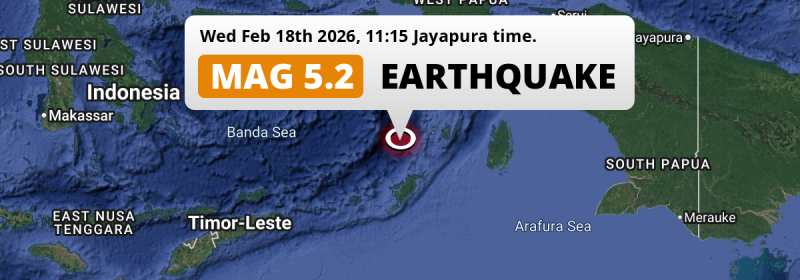
Significant M5.2 Earthquake hit in the Banda Sea 183km from Tual (Indonesia) on Wednesday Morning.
Feb 18, 2026 11:15AM
Significant M5.2 Earthquake hit in the Banda Sea 183km from Tual (Indonesia) on Wednesday Morning.
 Feb 17, 2026 08:47AM
On Tuesday Morning a Shallow M5.1 Earthquake struck in the Aru Sea 116km from Tual (Indonesia).
Feb 17, 2026 08:47AM
On Tuesday Morning a Shallow M5.1 Earthquake struck in the Aru Sea 116km from Tual (Indonesia).
 Feb 6, 2026 01:06AM
On Friday Night a Significant M5.8 Earthquake struck in the Indian Ocean 145km from Yogyakarta (Indonesia).
Feb 6, 2026 01:06AM
On Friday Night a Significant M5.8 Earthquake struck in the Indian Ocean 145km from Yogyakarta (Indonesia).
 Feb 4, 2026 09:36AM
Shallow M5.1 Earthquake struck on Wednesday Morning in the Banda Sea 154km from Tual (Indonesia).
Feb 4, 2026 09:36AM
Shallow M5.1 Earthquake struck on Wednesday Morning in the Banda Sea 154km from Tual (Indonesia).
 Jan 29, 2026 02:30AM
On Thursday Night a Significant M5.1 Earthquake struck near Dompu in Indonesia.
Jan 29, 2026 02:30AM
On Thursday Night a Significant M5.1 Earthquake struck near Dompu in Indonesia.
 Jan 27, 2026 08:20AM
Significant M5.7 Earthquake hit near Ponorogo in Indonesia on Tuesday Morning.
Jan 27, 2026 08:20AM
Significant M5.7 Earthquake hit near Ponorogo in Indonesia on Tuesday Morning.
Indonesia Earthquake Statistics
Average
A total of 20412 earthquakes with a magnitude of four or above have struck within 300 km (186 mi) of Indonesia in the past 10 years. This comes down to a yearly average of 2041 earthquakes per year, or 170 per month. On average an earthquake will hit near Indonesia roughly every 4 hours.
A relatively large number of earthquakes occurred near Indonesia in 2019. A total of 2907 earthquakes (mag 4+) were detected within 300 km of Indonesia that year. The strongest had a 7.2 magnitude.

Magnitude Distribution
The table below visualizes the distribution of all earthquakes that occurred within 300km of Indonesia in the past 10 years. No earthquakes with a magnitude of 8 or above have occurred near Indonesia during this time. Usually, higher magnitudes are less common than lower magnitudes. Small earthquakes with a magnitude below 4 on the Richter scale have been omitted from this overview.
| Magnitude | Earthquakes | Percentage |
|---|---|---|
| Mag. 4 | 18739 | 91.8% |
| Mag. 5 | 1566 | 7.67% |
| Mag. 6 | 99 | 0.49% |
| Mag. 7 | 8 | 0.04% |
| Mag. 8 | 0 | 0.0% |
| Mag. 9 | 0 | 0.0% |
| Mag. 10 | 0 | 0.0% |
Strongest earthquakes near Indonesia
The strongest recent earthquake of the past 10 years near Indonesia occurred on Sep 28, 2018 18:02 local time (Asia/Makassar timezone). It had a magnitude of 7.5 and struck 73 kilometers (45 mi) north of Palu, at a depth of 20 km. Discover more strong earthquakes near Indonesia in the list below.
A longer time ago, a MAG-9.3 earthquake struck on Dec 26, 2004 07:58, 85 kilometers (53 mi) north of Meulaboh. It is the strongest earthquake near Indonesia in the past 126 years (Our data goes back to January 1st, 1900).
In the table below you will find the strongest earthquakes that occurred near Indonesia in the past 10 years. You can use the tabs to find the heaviest historic earthquakes since the year 1900 or within a specific year or distance from Indonesia.
Earthquakes by region of Indonesia
Click the links below for earthquake reports for regions in Indonesia.
- Aceh
- Bali (Provinsi Bali)
- Banten (Provinsi Banten)
- Bengkulu
- Central Java (Jawa Tengah)
- Central Kalimantan (Provinsi Kalimantan Tengah)
- Central Sulawesi (Sulawesi Tengah)
- East Java (Jawa Timur)
- East Kalimantan (Kalimantan Timur)
- East Nusa Tenggara (Daerah Tingkat I Nusa Tenggara Timur)
- Gorontalo (Propinsi Gorontalo)
- Jakarta
- Jambi (Provinsi Jambi)
- Kepulauan Bangka Belitung
- Lampung (Provinsi Lampung)
- Maluku (Provinsi Maluku)
- North Kalimantan
- North Maluku (Provinsi Maluku Utara)
- North Sulawesi (Sulawesi Utara)
- North Sumatra (Daerah Tingkat I Sumatera Utara)
- Papua
- Provinsi Sulawesi Barat
- Riau
- Riau Islands (Kepulauan Riau)
- South Kalimantan (Kalimantan Selatan)
- South Sulawesi (Sulawesi Selatan)
- South Sumatra (Sumatera Selatan)
- Southeast Sulawesi (Provinsi Sulawesi Tenggara)
- West Java (Jawa Barat)
- West Kalimantan (Kalimantan Barat)
- West Nusa Tenggara (Propinsi Nusa Tenggara Barat)
- West Papua (Provinsi Papua Barat)
- West Sumatra (Sumatera Barat)
- Yogyakarta
Frequently Asked Questions
These questions are commonly asked in relation to earthquakes occurring near Indonesia.
When was the last earthquake in Indonesia?
A 3.1 magnitude earthquake hit near Indonesia on the morning of February 19, 2026 at 07:50 local time (Asia/Makassar). The center of this earthquake was located 58km east of Palu at a depth of 10km under land. Check the list on our website for any earthquakes occurring near Indonesia in the past hours.
What was the strongest earthquake near Indonesia?
A 9.3 magnitude earthquake hit near Indonesia on the morning of December 26, 2004 at 07:58 local time (Asia/Jakarta). The center of this earthquake was located 85km south-southwest of Meulaboh at a depth of 10km under water in the Indian Ocean. This is the strongest earthquake that occurred near Indonesia since the year 1900.
How often do earthquakes occur near Indonesia?
In the past 10 years, 20412 earthquakes with a magnitude of four or higher occurred within a 300 kilometer range from Indonesia. This averages to 2041 earthquakes yearly, or one earthquake every 4 hours.
