
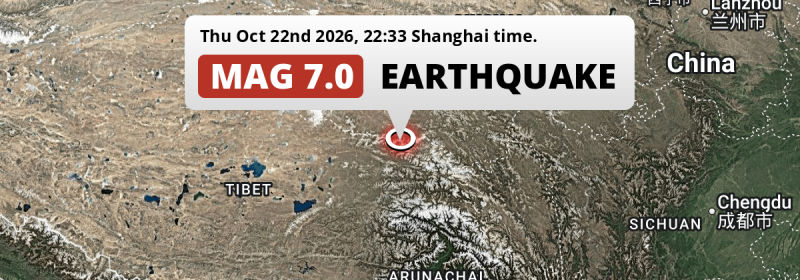
A DAMAGING and very strong MAG-7.0 earthquake struck under land 189 kilometer from Nagqu in China in the evening of Thursday October 22nd, 2026. Earthquakes like this can cause significant economic damage and have a significant risk at casualties.
Felt the earthquake? Share this article: 


Earthquake Summary
The earthquake struck on land in China, 189 kilometer (117 mi) north-east of Nagqu in Tibet. The center of this earthquake had a very shallow depth of 18 km. Shallow earthquakes usually have a larger impact than earthquakes deep in the earth.
| Date and Time: | Oct 22, 2026 22:33 (Shanghai Time) - Oct 22, 2026 14:33 Universal Time. |
|---|---|
| Location: | 189 km NE of Nagqu, Tibet, China. Coordinates 32°20'15"N 93°47'1"E. |
| Map: | 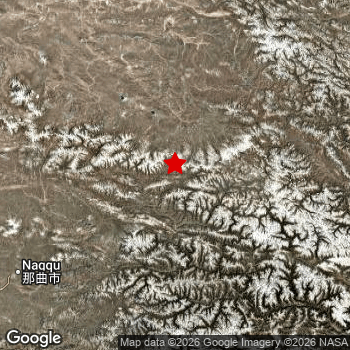 Map of area around epicenter. Click to open in Google Maps. |
| Magnitude: | MAG 7.0 Detected by 78 stations. Maximum Error Range ±0.035 . |
| Depth: | 18 km (11 mi) A very shallow depth. |
| Max. Intensity: | IX
Violent On the Modified Mercalli Scale. |
| Tsunami Risk: | Low Tsunami Risk Mag 6.5+ earthquakes at shallow depth can cause tsunami's, but this epicenter appears to have hit under land, making this less likely. Always stay cautious - More info here. |
Significant impact predicted
The US Geographic Survey (USGS) describes the impact of this earthquake as follows:
At least 16 persons killed and 76 injured. At least 339 homes destroyed, including 2 villages mostly destroyed and many buildings damaged; rockslides and ground cracks reported in Baqen.
Based on scientific estimates by the USGS, the risk of high fatalities for this earthquake is classified at level YELLOW (significant). They expect an 36% likelyhood of between 10 and 100 fatalities, and a 97% chance that the number of fatalities falls no higher than 1,000.
The USGS classifies the economic impact of this earthquake at level ORANGE (orange). They expect an 35% likelyhood of between 100 and 1,000 million US Dollars in economic damage and impact, and a 91% chance that the economic impact of this earthquake falls between 1 and 10,000 million USD.
Roughly 660 thousand people exposed to shaking
An estimated 660 thousand have been exposed to shaking (An MMI or Modified Mercalli Intensity level II or higher) as a result of this earthquake according scientific estimates published by the USGS.
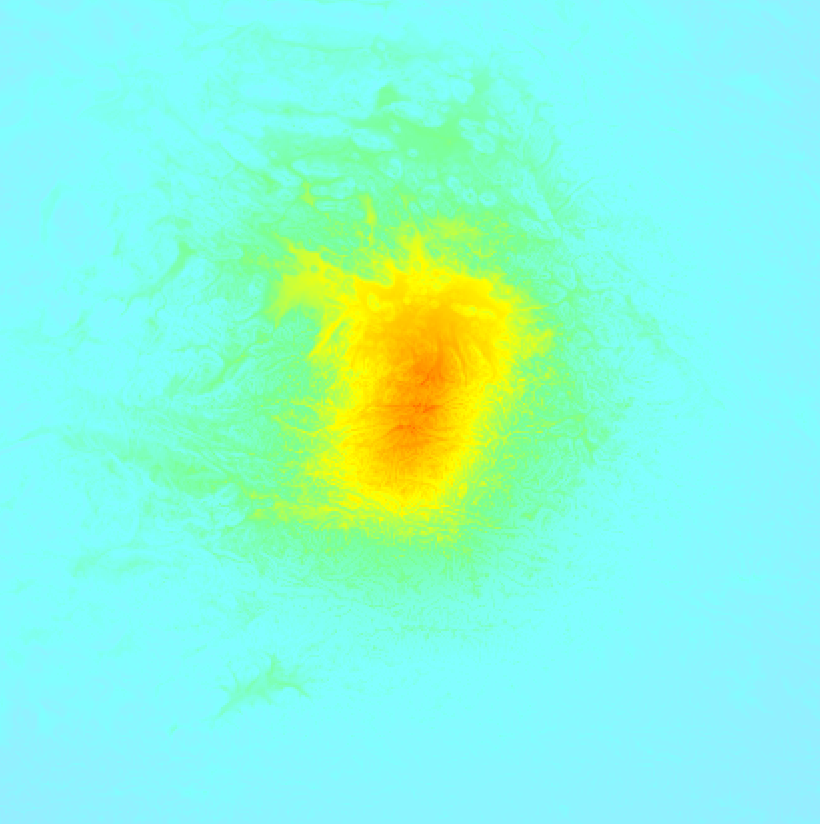
Violent shaking and likely heavy damage may have been experienced by an estimated 10 people. At IX, it is the highest MMI level this earthquake has caused. Intensity level IV was experienced by the majority of people (around 530 thousand). In their region, light shaking and likely no damage can be expected. All exposure to shaking was within the borders of China .
| People | MMI Level | Shaking | Damage |
|---|---|---|---|
| 0 | I |
Not noticable | None |
| 0 | II |
Very weak | None |
| 37,040 | III |
Weak | Probably none |
| 534,200 | IV |
Light | Likely none |
| 70,490 | V |
Moderate | Very light |
| 17,640 | VI |
Strong | Light |
| 2,050 | VII |
Very Strong | Moderate |
| 2,340 | VIII |
Severe | Moderate to heavy |
| 10 | IX |
Violent | Heavy |
| 0 | X |
Extreme | Very heavy |
Nearby towns and cities
This earthquake may have been felt in China . The closest significant population center near the earthquake is Nagqu in Tibet, China. Nagqu is located 189 kilometer (117 mi) north-east of the epicenter. Nagqu experienced an earthquake intensity (MMI Scale) of roughly IV. That level implies light shaking and likely no damage.
A complete list of nearby places is included below. Estimated intensity data (MMI) sourced from a shake-map published by the US Geographic Survey is shown where available (cities without data probably experienced little impact).
Overview of nearby places
| Distance | Place | Intensity (MMI) |
|---|---|---|
| 189 km (117 mi) SW from epicenter |
Nagqu Tibet, China. |
IV
Light |
| 348 km (216 mi) E from epicenter |
Qamdo Tibet, China. |
|
| 393 km (244 mi) SW from epicenter |
Lhasa Tibet, China. |
|
| 393 km (244 mi) SW from epicenter |
Dêqên Tibet, China. |
|
| 474 km (295 mi) S from epicenter |
Along Arunachal Pradesh, India. |
|
| 498 km (309 mi) S from epicenter |
Pāsighāt Arunachal Pradesh, India. |
Earthquake Intensity Map
The graph below overlays a map of the region around the epicenter with earthquake intensity data provided by the US Geographic Survey. The highest intensity level detected for this earthquake is IX.
Shaking reported by 6 people in 3 countries
People that feel an earthquake may report their experience to the US Geographic Survey. Currently, 6 people have reported shaking in 6 places in 3 countries (India, Nepal, China).We keep updating this article as more ground reports become available. You may report that you felt this earthquake here.
Places with most reports:
- Dulia Gaon, Assam, India: 1 person.
- Bhimeshwar, Dolakha, Nepal: 1 person.
- Khadbari, Sankhuwasabha, Nepal: 1 person.
- Lasa, Xizang, China: 1 person.
- Suriyawan, Uttar Pradesh, India: 1 person.
- Chongqing, Chongqing, China: 1 person.
32 Aftershocks detected
Since this main shock, 32 smaller aftershocks were detected. Just 3 days after this main shock, an earthquake measuring MAG-5.9 was detected 26 km (16 mi) north-east of this earthquake.
Overview of foreshocks and aftershocks
| Classification | Magnitude | When | Where |
|---|---|---|---|
| Main Shock This Earthquake |
M 7.0 |
Oct 22, 2026 22:33 (Shanghai Time) | - |
| Aftershock | M 4.5 |
13 mins later Oct 22, 2026 22:46 (Shanghai Time) | 39 km (24 mi) E from Main Shock. |
| Aftershock | M 4.6 |
26 mins later Oct 22, 2026 22:59 (Shanghai Time) | 5 km (3 mi) NW from Main Shock. |
| Aftershock | M 5.2 |
38 mins later Oct 22, 2026 23:12 (Shanghai Time) | 9 km (6 mi) NE from Main Shock. |
| Aftershock | M 4.9 |
40 mins later Oct 22, 2026 23:13 (Shanghai Time) | 18 km (11 mi) NE from Main Shock. |
| Aftershock | M 4.4 |
45 mins later Oct 22, 2026 23:18 (Shanghai Time) | 45 km (28 mi) N from Main Shock. |
| Aftershock | M 4.3 |
46 mins later Oct 22, 2026 23:20 (Shanghai Time) | 32 km (20 mi) N from Main Shock. |
| Aftershock | M 4.4 |
1 hr later Oct 22, 2026 23:39 (Shanghai Time) | 13 km (8 mi) SE from Main Shock. |
| Aftershock | M 4.3 |
1 hr later Oct 22, 2026 23:52 (Shanghai Time) | 36 km (22 mi) NE from Main Shock. |
| Aftershock | M 4.3 |
1 hr later Oct 22, 2026 23:57 (Shanghai Time) | 29 km (18 mi) NE from Main Shock. |
| Aftershock | M 4.5 |
2 hrs later Oct 23, 2026 00:17 (Shanghai Time) | 51 km (32 mi) N from Main Shock. |
| Aftershock | M 4.9 |
2 hrs later Oct 23, 2026 00:21 (Shanghai Time) | 18 km (11 mi) N from Main Shock. |
| Aftershock | M 4.6 |
2 hrs later Oct 23, 2026 00:45 (Shanghai Time) | 5 km (3 mi) NW from Main Shock. |
| Aftershock | M 4.5 |
2 hrs later Oct 23, 2026 00:50 (Shanghai Time) | 23 km (14 mi) NE from Main Shock. |
| Aftershock | M 4.7 |
2 hrs later Oct 23, 2026 00:57 (Shanghai Time) | 0.4 km (0.2 mi) NW from Main Shock. |
| Aftershock | M 5.0 |
4 hrs later Oct 23, 2026 02:06 (Shanghai Time) | 26 km (16 mi) E from Main Shock. |
| Aftershock | M 4.4 |
10 hrs later Oct 23, 2026 08:24 (Shanghai Time) | 31 km (19 mi) N from Main Shock. |
| Aftershock | M 4.1 |
10 hrs later Oct 23, 2026 08:35 (Shanghai Time) | 21 km (13 mi) E from Main Shock. |
| Aftershock | M 4.4 |
12 hrs later Oct 23, 2026 10:53 (Shanghai Time) | 4 km (2.4 mi) SE from Main Shock. |
| Aftershock | M 4.1 |
13 hrs later Oct 23, 2026 11:13 (Shanghai Time) | 9 km (5 mi) N from Main Shock. |
| Aftershock | M 4.2 |
18 hrs later Oct 23, 2026 16:33 (Shanghai Time) | 39 km (24 mi) NE from Main Shock. |
| Aftershock | M 4.7 |
24 hrs later Oct 23, 2026 22:14 (Shanghai Time) | 37 km (23 mi) NE from Main Shock. |
| Aftershock | M 4.4 |
1 day later Oct 23, 2026 22:41 (Shanghai Time) | 38 km (24 mi) NE from Main Shock. |
| Aftershock | M 4.1 |
1 day later Oct 23, 2026 23:18 (Shanghai Time) | 65 km (41 mi) W from Main Shock. |
| Aftershock | M 4.0 |
1 day later Oct 24, 2026 03:37 (Shanghai Time) | 13 km (8 mi) N from Main Shock. |
| Aftershock | M 4.8 |
1 day later Oct 24, 2026 04:37 (Shanghai Time) | 16 km (10 mi) NE from Main Shock. |
| Aftershock | M 4.3 |
1 day later Oct 24, 2026 06:39 (Shanghai Time) | 38 km (24 mi) NE from Main Shock. |
| Aftershock | M 4.9 |
1 day later Oct 24, 2026 08:07 (Shanghai Time) | 23 km (14 mi) NE from Main Shock. |
| Aftershock | M 5.3 |
2 days later Oct 24, 2026 16:39 (Shanghai Time) | 31 km (19 mi) NE from Main Shock. |
| Aftershock | M 4.6 |
2 days later Oct 24, 2026 21:26 (Shanghai Time) | 27 km (17 mi) N from Main Shock. |
| Aftershock | M 5.0 |
3 days later Oct 25, 2026 19:24 (Shanghai Time) | 8 km (5 mi) NE from Main Shock. |
| Aftershock | M 5.9 |
3 days later Oct 25, 2026 19:25 (Shanghai Time) | 26 km (16 mi) NE from Main Shock. |
| Aftershock | M 4.4 |
3 days later Oct 25, 2026 19:55 (Shanghai Time) | 43 km (27 mi) N from Main Shock. |
More earthquakes coming?
Aftershocks are usually at least 1 order of magnitude less strong than main shocks. The more time passes, the smaller the chance and likely strength of any potential aftershocks.
The chance that a significant earthquake like this one is followed by an even larger earthquake is not so large. On average, scientists estimate a 94% chance that a major earthquake will not be followed by an even larger one. It is still adviced to be aware of this risk
Read: How to Stay Safe during an Earthquake (cdc.gov).This is an unusually powerful earthquake
No earthquake of this strength has struck this region for a long time. Our data goes back 10 years, and no earthquakes measuring a magnitude of 7 or higher have been detected within 300 km (186 mi) of this epicenter.
Low Tsunami Risk
There is a low tsunami risk following this earthquake, as it appears the epicenter was under land far away from the coast. However this was a very strong earthquake at a shallow depth that would have a very high risk at causing tsunami's if it would have occurred under sea. Stay cautious and monitor advice from local authorities.
Tsunami Risk Factors
| Factor | Under Sea? | MAG-6.5 or stronger? | Shallow depth? |
|---|---|---|---|
| Explanation | Almost all tsunami's are caused by earthquakes with their epicenter under sea or very near the sea. However stay cautious in coastal areas as earthquakes on land may cause landslides into sea, potentially still causing a local tsunami. | Under MAG 6.5: Very unlikely to cause a tsunami. MAG 6.5 to 7.5: Destructive tsunami's do occur, but are uncommon. Likely to observe small sea level changes. MAG 7.6+: Earthquakes with these magnitudes might produce destructive tsunami's. |
Most destructive tsunami's are caused by shallow earthquakes with a depth between 0 and 100km under the surface of the earth. Deeper tsunami's are unlikely to displace to ocean floor. |
| This Earthquake | Not this earthquake. This earthquake appears to have struck on land far from any coast. |
This earthquake had a magnitude of 7. Earthquakes of this strength could trigger a tsunami. | This earthquake occurred at a depth of of 18 km (11 mi). Earthquakes this shallow could trigger a tsunami. |
Sources
Last updated 22/11/26 02:28 (). This article contains currently available information about the earthquake and is automatically composed. We continue to update this article up to a few days after the earthquake occurred.
- US Geographic Society (USGS): Earthquake us6000u43g
- European-Mediterranean Seismological Centre (EMSC): Earthquake 20261022_0000241
- Geonames.org: World Cities Database
- Google Maps: Static API
- Earthquakelist.org: Historic Earthquakes Database
Share this article:
