
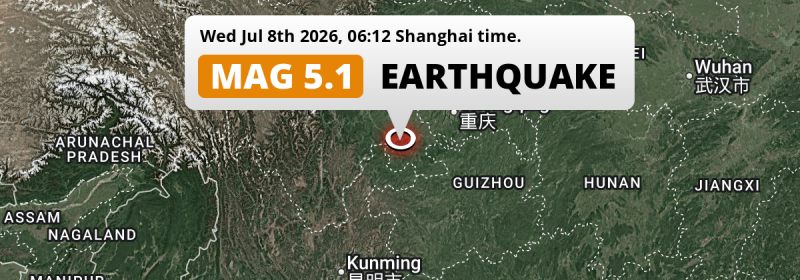
Under land 22 kilometer from Yibin in China, a shallow and significant Magnitude 5.0 earthquake occurred in the early morning of Wednesday July 8th, 2026. The earthquake struck near a very densely populated region.
Felt the earthquake? Share this article: 


Earthquake Summary
The earthquake struck on land in China, 22 kilometer (14 mi) south of Yibin in Sichuan. The center of this earthquake had a very shallow depth of 10 km. Shallow earthquakes usually have a larger impact than earthquakes deep in the earth.
| Date and Time: | Jul 8, 2026 06:12 (Shanghai Time) - Jul 7, 2026 22:12 Universal Time. |
|---|---|
| Location: | 22 km south of Yibin, Sichuan, China. Coordinates 28°34'26"N 104°42'40"E. |
| Map: | 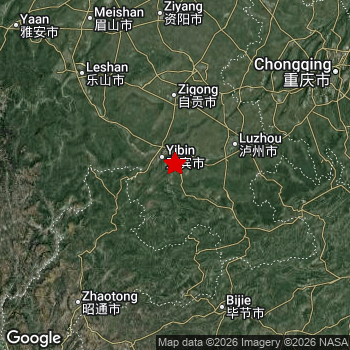 Map of area around epicenter. Click to open in Google Maps. |
| Magnitude: | MAG 5.0 Detected by 24 stations. Maximum Error Range ±0.063 . |
| Depth: | 10 km (6 mi) A very shallow depth. |
| Tsunami Risk: | Tsunami very unlikely While this was a shallow earthquake, it appears to have occurred under land with a magnitude not strong enough to cause tsunami's. Always stay cautious - More info here. |
Nearby towns and cities
This earthquake may have been felt in China . The closest significant population center near the earthquake is Xunchang in Sichuan, China. Xunchang is located 13 kilometer (8 mi) north of the epicenter.
Multiple major population centers exist within 300km of the earthquake that struck today. Chengdu is located 241 km to the north. Yibin is located 22 km to the north. Chongqing is located 210 km to the north-east.
A complete list of nearby places is included below.
Overview of nearby places
| Distance | Place |
|---|---|
| 13 km (8 mi) S from epicenter |
Xunchang Sichuan, China. |
| 20 km (12 mi) E from epicenter |
Changning Sichuan, China. |
| 21 km (13 mi) NW from epicenter |
Baixi Sichuan, China. |
| 22 km (14 mi) N from epicenter |
Yibin Sichuan, China. |
| 24 km (15 mi) SW from epicenter |
Qingfu Sichuan, China. |
| 25 km (16 mi) SW from epicenter |
Wenjiang Sichuan, China. |
| 31 km (19 mi) W from epicenter |
Xiangjiaba Yunnan, China. |
| 32 km (20 mi) NE from epicenter |
Luolong Sichuan, China. |
| 38 km (24 mi) W from epicenter |
Shuanglong Sichuan, China. |
| 39 km (24 mi) NE from epicenter |
Jiang’an Sichuan, China. |
| 40 km (25 mi) NE from epicenter |
Nanxi Sichuan, China. |
| 45 km (28 mi) SE from epicenter |
Bowangshan Sichuan, China. |
| 49 km (30 mi) SW from epicenter |
Junlian Sichuan, China. |
| 55 km (34 mi) S from epicenter |
Xunsi Sichuan, China. |
| 59 km (37 mi) SE from epicenter |
Gusong Sichuan, China. |
| 59 km (37 mi) N from epicenter |
Baihua Sichuan, China. |
| 59 km (37 mi) NW from epicenter |
Juexi Sichuan, China. |
| 63 km (39 mi) N from epicenter |
Kongtan Sichuan, China. |
| 64 km (40 mi) E from epicenter |
Huguo Sichuan, China. |
| 66 km (41 mi) NW from epicenter |
Guanyin Sichuan, China. |
| 68 km (42 mi) E from epicenter |
Naxi Sichuan, China. |
| 78 km (48 mi) NE from epicenter |
Luzhou Sichuan, China. |
| 84 km (52 mi) SE from epicenter |
Xuyong Sichuan, China. |
| 86 km (53 mi) N from epicenter |
Zigong Sichuan, China. |
| 91 km (57 mi) NE from epicenter |
Fuji Sichuan, China. |
| 101 km (63 mi) NE from epicenter |
Taifu Sichuan, China. |
| 107 km (66 mi) NE from epicenter |
Yunjin Sichuan, China. |
| 109 km (68 mi) NE from epicenter |
Xuantan Sichuan, China. |
| 112 km (70 mi) NW from epicenter |
Luocheng Sichuan, China. |
| 113 km (70 mi) E from epicenter |
Hejiang Sichuan, China. |
| 117 km (73 mi) N from epicenter |
Neijiang Sichuan, China. |
| 123 km (76 mi) SE from epicenter |
Gulin Sichuan, China. |
| 143 km (89 mi) NW from epicenter |
Leshan Sichuan, China. |
| 148 km (92 mi) E from epicenter |
Baisha Chongqing, China. |
| 150 km (93 mi) NE from epicenter |
Longshui Chongqing, China. |
| 152 km (94 mi) S from epicenter |
Bijie Guizhou, China. |
| 170 km (106 mi) NE from epicenter |
Jijiang Chongqing, China. |
| 171 km (106 mi) SW from epicenter |
Zhaotong Yunnan, China. |
| 172 km (107 mi) N from epicenter |
Ziyang Sichuan, China. |
| 184 km (114 mi) NW from epicenter |
Meishan Sichuan, China. |
| 186 km (116 mi) NE from epicenter |
Bishan Chongqing, China. |
| 199 km (124 mi) NE from epicenter |
Banan Chongqing, China. |
| 210 km (130 mi) NE from epicenter |
Chongqing Chongqing, China. |
| 220 km (137 mi) S from epicenter |
Liupanshui Guizhou, China. |
| 228 km (142 mi) NW from epicenter |
Ya'an Sichuan, China. |
| 231 km (144 mi) N from epicenter |
Suining Sichuan, China. |
| 237 km (147 mi) SE from epicenter |
Zunyi Guizhou, China. |
| 241 km (150 mi) N from epicenter |
Chengdu Sichuan, China. |
| 280 km (174 mi) NE from epicenter |
Nanchong Sichuan, China. |
| 282 km (175 mi) NE from epicenter |
Guang’an Sichuan, China. |
| 297 km (185 mi) SE from epicenter |
Guiyang Guizhou, China. |
Shaking reported by 4 people
People that feel an earthquake may report their experience to the US Geographic Survey. Currently, 4 people have reported shaking in 2 places in China.We keep updating this article as more ground reports become available. You may report that you felt this earthquake here.
Places with most reports:
- Huayang, Sichuan, China: 2 people.
- Chengdu, Sichuan, China: 2 people.
13 Aftershocks detected
This main shock was followed by 13 smaller aftershocks. A 5 magnitude earthquake hit 1 day later 1.3 km (0.8 mi) north-east of this earthquake.
This main shock was prefaced by 1 smaller foreshock. A 4.5 magnitude earthquake hit 2 hrs earlier nearby.
Overview of foreshocks and aftershocks
| Classification | Magnitude | When | Where |
|---|---|---|---|
| Foreshock | M 4.5 |
2 hrs earlier Jul 8, 2026 04:01 (Shanghai Time) | 2.8 km (1.7 mi) SW from Main Shock. |
| Main Shock This Earthquake |
M 5.0 |
Jul 8, 2026 06:12 (Shanghai Time) | - |
| Aftershock | M 3.1 |
2 mins later Jul 8, 2026 06:14 (Shanghai Time) | 4 km (2.5 mi) SW from Main Shock. |
| Aftershock | M 3.0 |
5 mins later Jul 8, 2026 06:17 (Shanghai Time) | 6 km (4 mi) SW from Main Shock. |
| Aftershock | M 4.4 |
7 mins later Jul 8, 2026 06:19 (Shanghai Time) | 13 km (8 mi) S from Main Shock. |
| Aftershock | M 4.6 |
10 mins later Jul 8, 2026 06:22 (Shanghai Time) | 7 km (4 mi) SE from Main Shock. |
| Aftershock | M 3.2 |
36 mins later Jul 8, 2026 06:48 (Shanghai Time) | 6 km (4 mi) SW from Main Shock. |
| Aftershock | M 5.0 |
4 hrs later Jul 8, 2026 10:08 (Shanghai Time) | 21 km (13 mi) SW from Main Shock. |
| Aftershock | M 3.0 |
7 hrs later Jul 8, 2026 13:05 (Shanghai Time) | 8 km (5 mi) SW from Main Shock. |
| Aftershock | M 5.0 |
1 day later Jul 9, 2026 07:44 (Shanghai Time) | 1.3 km (0.8 mi) NE from Main Shock. |
| Aftershock | M 3.2 |
1 day later Jul 9, 2026 12:25 (Shanghai Time) | 6 km (4 mi) S from Main Shock. |
| Aftershock | M 3.2 |
2 days later Jul 10, 2026 14:05 (Shanghai Time) | 5 km (3 mi) S from Main Shock. |
| Aftershock | M 3.3 |
2 days later Jul 10, 2026 17:38 (Shanghai Time) | 7 km (4 mi) SW from Main Shock. |
| Aftershock | M 3.2 |
3 days later Jul 10, 2026 19:48 (Shanghai Time) | 5 km (3 mi) S from Main Shock. |
| Aftershock | M 3.1 |
3 days later Jul 10, 2026 20:23 (Shanghai Time) | 6 km (3 mi) SW from Main Shock. |
More earthquakes coming?
Aftershocks are usually at least 1 order of magnitude less strong than main shocks. The more time passes, the smaller the chance and likely strength of any potential aftershocks.
In only six percent of cases, significant earthquakes are followed by a larger main shock, making the current earthquake a foreshock. While the chance of this happening is not so large, it is adviced to maintain cautiousness in the hours and days following a major earthquake.
Read: How to Stay Safe during an Earthquake (cdc.gov).Earthquakes like this happen often in the region
Earthquakes of this strength are very common in the region. This is the strongest earthquake to hit since June 28th, 2026, when a 5.2 magnitude earthquake hit 11 km (7 mi) further north-east. An even stronger magnitude 6.6 earthquake struck on September 5th, 2022.
In total, 25 earthquakes with a magnitude of 5 or higher have been registered within 300km (186 mi) of this epicenter in the past 10 years. This comes down to an average of once every 5 months.
Tsunami very unlikely
While MAG-6.5+ earthquakes may cause tsunami's, it appears that the epicenter of this earthquake hit under land. In addition, the reported depth is deeper than 100km, making the risk of a tsunami even less likely. However always stay cautious and monitor advice from local authorities.
Tsunami Risk Factors
| Factor | Under Sea? | MAG-6.5 or stronger? | Shallow depth? |
|---|---|---|---|
| Explanation | Almost all tsunami's are caused by earthquakes with their epicenter under sea or very near the sea. However stay cautious in coastal areas as earthquakes on land may cause landslides into sea, potentially still causing a local tsunami. | Under MAG 6.5: Very unlikely to cause a tsunami. MAG 6.5 to 7.5: Destructive tsunami's do occur, but are uncommon. Likely to observe small sea level changes. MAG 7.6+: Earthquakes with these magnitudes might produce destructive tsunami's. |
Most destructive tsunami's are caused by shallow earthquakes with a depth between 0 and 100km under the surface of the earth. Deeper tsunami's are unlikely to displace to ocean floor. |
| This Earthquake | Not this earthquake. This earthquake appears to have struck on land far from any coast. |
Not this earthquake. This earthquake had a magnitude of 5. Earthquakes of this strength are unlikely to trigger a tsunami. |
This earthquake occurred at a depth of of 10 km (6 mi). Earthquakes this shallow could trigger a tsunami. |
Sources
Last updated 31/07/26 00:38 (). This article contains currently available information about the earthquake and is automatically composed. We continue to update this article up to a few days after the earthquake occurred.
- US Geographic Society (USGS): Earthquake us6000tatd
- European-Mediterranean Seismological Centre (EMSC): Earthquake 20260707_0000318
- Geonames.org: World Cities Database
- Google Maps: Static API
- Earthquakelist.org: Historic Earthquakes Database
Share this article:
