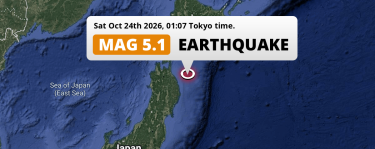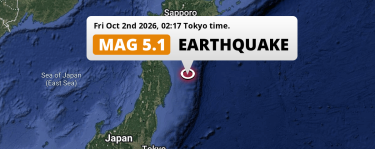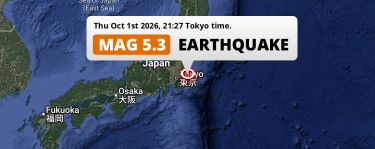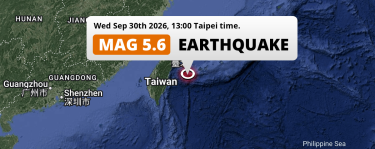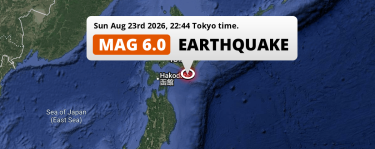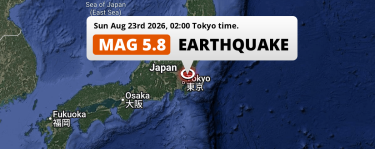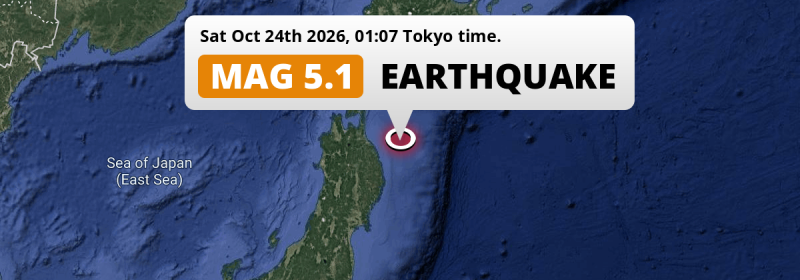
In the North Pacific Ocean 62 kilometer from Hachinohe, Japan, a strong MAG-6.9 earthquake occurred in the morning of Thursday June 25th, 2026. Mag 6.5+ earthquakes at shallow depth under sea have the potential to cause tsunami's.
Felt the earthquake? Share this article:

Earthquake Summary
This earthquake hit under water in the North Pacific Ocean, 35 kilometers (22 mi) off the coast of Japan, 62 kilometer south-east of Hachinohe in Aomori. The center of this earthquake had a quite shallow depth of 34 km. Shallow earthquakes usually have a larger impact than earthquakes deep in the earth.
| Date and Time: | Jun 25, 2026 07:30 (Tokyo Time) - Jun 24, 2026 22:30 Universal Time. |
|---|---|
| Location: | 62 km SE of Hachinohe, Aomori, Japan. Coordinates 40°15'5"N 142°9'41"E. |
| Map: | ![]() Map of area around epicenter. Click to open in Google Maps. |
| Magnitude: | MAG 6.9 Detected by 41 stations. Maximum Error Range ±0.053 . |
| Depth: | 34 km (21 mi) A quite shallow depth. |
| Max. Intensity: | VII
Very Strong On the Modified Mercalli Scale. |
| Tsunami Risk: | Potential Tsunami Risk Mag 6.5+ earthquakes at shallow depth under sea have the potential to cause tsunami's. Always stay cautious - More info here. |
Potential Tsunami Risk
There is a potential tsunami risk in the aftermath of this earthquake, immediately evacuate to higher grounds away from coastal areas and monitor advice from local authorities. This earthquake checks all the likely tsunami risk factors: under sea, at a magnitude of MAG-6.5+ and at a shallow depth.
Tsunami Risk Factors
| Factor | Under Sea? | MAG-6.5 or stronger? | Shallow depth? |
|---|---|---|---|
| Explanation | Almost all tsunami's are caused by earthquakes with their epicenter under sea or very near the sea. However stay cautious in coastal areas as earthquakes on land may cause landslides into sea, potentially still causing a local tsunami. | Under MAG 6.5: Very unlikely to cause a tsunami. MAG 6.5 to 7.5: Destructive tsunami's do occur, but are uncommon. Likely to observe small sea level changes. MAG 7.6+: Earthquakes with these magnitudes might produce destructive tsunami's. |
Most destructive tsunami's are caused by shallow earthquakes with a depth between 0 and 100km under the surface of the earth. Deeper tsunami's are unlikely to displace to ocean floor. |
| This Earthquake | This earthquake appears to have struck under the sea. | This earthquake had a magnitude of 6.9. Earthquakes of this strength could trigger a tsunami. | This earthquake occurred at a depth of of 34 km (21 mi). Earthquakes this shallow could trigger a tsunami. |
Significant economic impact
The US Geographic Survey (USGS) describes the impact of this earthquake as follows:
Ten persons injured, at least 5 homes and 361 buildings damaged, power outages ocurred in Aomori; 2 persons injured and at least 2 buildings damaged in Iwate.
Based on scientific estimates by the USGS, the risk of high fatalities for this earthquake is classified at level GREEN (low). They expect an 90% likelyhood of between 0 and 1 fatalities.
The USGS classifies the economic impact of this earthquake at level YELLOW (significant). They expect an 48% likelyhood of between 0 and 1 million US Dollars in economic damage and impact, and a 98% chance that the economic impact of this earthquake falls no higher than 100 million USD.
Roughly 4.7 million people exposed to shaking
The USGS has published a report estimating the number of people exposed to this earthquake. Acoording to their analysis, roughly 4.7 million have been exposed to shaking at an MMI level of II or higher.
The highest earthquake impact level for this earthquake is VII, which corresponds with very strong shaking and likely moderate damage. Roughly 35,490 people are expected to be exposed to this level. Intensity level IV was experienced by the majority of people (around 2.5 million). In their region, light shaking and likely no damage can be expected. All exposure to shaking was within the borders of Japan .
| People | MMI Level | Shaking | Damage |
|---|---|---|---|
| 0 | I |
Not noticable | None |
| 0 | II |
Very weak | None |
| 6,540 | III |
Weak | Probably none |
| 2,533,000 | IV |
Light | Likely none |
| 1,725,000 | V |
Moderate | Very light |
| 403,000 | VI |
Strong | Light |
| 35,490 | VII |
Very Strong | Moderate |
| 0 | VIII |
Severe | Moderate to heavy |
| 0 | IX |
Violent | Heavy |
| 0 | X |
Extreme | Very heavy |
Nearby towns and cities
This earthquake may have been felt in Japan . The closest significant population center near the earthquake is Hachinohe in Aomori, Japan. Hachinohe is located 62 kilometer (39 mi) south-east of the epicenter. The intensity of shaking and damage in Hachinohe is estimated to be around level VI on the Modified Mercalli Intensity scale (strong shaking, probably light damage).
Multiple large cities are in proximity of today's earthquake. Sapporo is located 320 km to the north (intensity unknown, possibly low). Sendai is located 247 km to the southwest (intensity unknown, possibly low). Hachinohe is located 62 km to the northwest and experienced an intensity of VI (strong shaking, probably light damage).
An overview of nearby towns and cities is available in the overview below. If places don't have intensity data available, it likely means the experienced impact in those places was fairly small.
Overview of nearby places
| Distance | Place | Intensity (MMI) |
|---|---|---|
| 62 km (39 mi) NW from epicenter |
Hachinohe Aomori, Japan. |
VI
Strong |
| 70 km (43 mi) S from epicenter |
Miyako Iwate, Japan. |
V
Moderate |
| 81 km (50 mi) NW from epicenter |
Misawa Aomori, Japan. |
VI
Strong |
| 89 km (55 mi) S from epicenter |
Yamada Iwate, Japan. |
VI
Strong |
| 106 km (66 mi) SW from epicenter |
Morioka Iwate, Japan. |
V
Moderate |
| 111 km (69 mi) S from epicenter |
Kamaishi Iwate, Japan. |
IV
Light |
| 117 km (73 mi) SW from epicenter |
Tōno Iwate, Japan. |
V
Moderate |
| 117 km (73 mi) W from epicenter |
Hanawa Akita, Japan. |
V
Moderate |
| 118 km (73 mi) SW from epicenter |
Shizukuishi Iwate, Japan. |
V
Moderate |
| 131 km (81 mi) SW from epicenter |
Hanamaki Iwate, Japan. |
V
Moderate |
| 136 km (85 mi) W from epicenter |
Ōdate Akita, Japan. |
V
Moderate |
| 136 km (85 mi) NW from epicenter |
Aomori Aomori, Japan. |
V
Moderate |
| 137 km (85 mi) S from epicenter |
Ōfunato Iwate, Japan. |
V
Moderate |
| 140 km (87 mi) SW from epicenter |
Kitakami Iwate, Japan. |
IV
Light |
| 140 km (87 mi) NW from epicenter |
Mutsu Aomori, Japan. |
V
Moderate |
| 141 km (88 mi) W from epicenter |
Kuroishi Aomori, Japan. |
V
Moderate |
| 142 km (88 mi) W from epicenter |
Namioka Aomori, Japan. |
V
Moderate |
| 147 km (91 mi) SW from epicenter |
Kanegasaki Iwate, Japan. |
V
Moderate |
| 148 km (92 mi) W from epicenter |
Hirosaki Aomori, Japan. |
V
Moderate |
| 152 km (94 mi) SW from epicenter |
Mizusawa Iwate, Japan. |
IV
Light |
| 152 km (94 mi) W from epicenter |
Takanosu Akita, Japan. |
IV
Light |
| 158 km (98 mi) W from epicenter |
Goshogawara Aomori, Japan. |
V
Moderate |
| 163 km (101 mi) W from epicenter |
Shimokizukuri Aomori, Japan. |
V
Moderate |
| 169 km (105 mi) SW from epicenter |
Ōmagari Akita, Japan. |
V
Moderate |
| 172 km (107 mi) SW from epicenter |
Yokote Akita, Japan. |
IV
Light |
| 173 km (107 mi) SW from epicenter |
Ichinoseki Iwate, Japan. |
IV
Light |
| 181 km (112 mi) W from epicenter |
Noshiro Akita, Japan. |
V
Moderate |
| 184 km (114 mi) W from epicenter |
Akita Akita, Japan. |
IV
Light |
| 186 km (116 mi) SW from epicenter |
Yuzawa Akita, Japan. |
IV
Light |
| 191 km (119 mi) W from epicenter |
Tennō Akita, Japan. |
V
Moderate |
| 207 km (129 mi) NW from epicenter |
Hakodate Hokkaido, Japan. |
IV
Light |
| 214 km (133 mi) SW from epicenter |
Furukawa Miyagi, Japan. |
IV
Light |
| 217 km (135 mi) S from epicenter |
Ishinomaki Miyagi, Japan. |
IV
Light |
| 234 km (145 mi) SW from epicenter |
Tomiya Miyagi, Japan. |
IV
Light |
| 236 km (147 mi) SW from epicenter |
Shiogama Miyagi, Japan. |
|
| 247 km (153 mi) SW from epicenter |
Sendai Miyagi, Japan. |
|
| 247 km (153 mi) SW from epicenter |
Sakata Yamagata, Japan. |
IV
Light |
| 250 km (155 mi) NW from epicenter |
Muroran Hokkaido, Japan. |
|
| 261 km (162 mi) SW from epicenter |
Tendō Yamagata, Japan. |
|
| 263 km (163 mi) SW from epicenter |
Tsuruoka Yamagata, Japan. |
IV
Light |
| 269 km (167 mi) N from epicenter |
Tomakomai Hokkaido, Japan. |
|
| 272 km (169 mi) SW from epicenter |
Yamagata Yamagata, Japan. |
|
| 289 km (180 mi) N from epicenter |
Chitose Hokkaido, Japan. |
|
| 309 km (192 mi) N from epicenter |
Obihiro Hokkaido, Japan. |
|
| 314 km (195 mi) SW from epicenter |
Fukushima Fukushima, Japan. |
|
| 320 km (199 mi) N from epicenter |
Sapporo Hokkaido, Japan. |
|
| 352 km (219 mi) SW from epicenter |
Kōriyama Fukushima, Japan. |
|
| 354 km (220 mi) NE from epicenter |
Kushiro Hokkaido, Japan. |
|
| 373 km (232 mi) S from epicenter |
Iwaki Fukushima, Japan. |
|
| 379 km (235 mi) SW from epicenter |
Niigata Niigata, Japan. |
|
| 392 km (244 mi) N from epicenter |
Asahikawa Hokkaido, Japan. |
|
| 455 km (283 mi) SW from epicenter |
Utsunomiya Tochigi, Japan. |
|
| 459 km (285 mi) S from epicenter |
Mito Ibaraki, Japan. |
|
| 494 km (307 mi) SW from epicenter |
Kiryū Gunma, Japan. |
Earthquake Intensity Map
The graph below overlays a map of the region around the epicenter with earthquake intensity data provided by the US Geographic Survey. The highest intensity level detected for this earthquake is VII.
Shaking reported by 93 people
People that feel an earthquake may report their experience to the US Geographic Survey. Currently, 93 people have reported shaking in 40 places, all within Japan.We keep updating this article as more ground reports become available. You may report that you felt this earthquake here.
Places with most reports:
- Tokyo, Tokio, Japan: 19 people.
- Sendai, Miyagi, Japan: 9 people.
- Sapporo, Hokkaido, Japan: 9 people.
- Hachinohe, Aomori, Japan: 7 people.
- Misawa, Aomori, Japan: 4 people.
- Kawasaki, Kanagawa, Japan: 4 people.
- Urayasu, Chiba, Japan: 3 people.
- Ichikawa, Chiba, Japan: 2 people.
- Hitachi, Ibaraki, Japan: 2 people.
- Chiba, Chiba, Japan: 2 people.
15 Aftershocks detected
This main shock was followed by 15 smaller aftershocks. At a distance of 22 km (14 mi) east of this earthquake, an aftershock struck 3 days later. It measured a magnitude of 5.8
Overview of foreshocks and aftershocks
| Classification | Magnitude | When | Where |
|---|---|---|---|
| Main Shock This Earthquake |
M 6.9 |
Jun 25, 2026 07:30 (Tokyo Time) | - |
| Aftershock | M 3.6 |
36 mins later Jun 25, 2026 08:06 (Tokyo Time) | 13 km (8 mi) SE from Main Shock. |
| Aftershock | M 3.3 |
42 mins later Jun 25, 2026 08:12 (Tokyo Time) | 6 km (4 mi) NE from Main Shock. |
| Aftershock | M 3.1 |
52 mins later Jun 25, 2026 08:22 (Tokyo Time) | 6 km (4 mi) NE from Main Shock. |
| Aftershock | M 3.9 |
2 hrs later Jun 25, 2026 09:08 (Tokyo Time) | 13 km (8 mi) SE from Main Shock. |
| Aftershock | M 4.3 |
2 hrs later Jun 25, 2026 09:33 (Tokyo Time) | 22 km (13 mi) NE from Main Shock. |
| Aftershock | M 4.1 |
3 hrs later Jun 25, 2026 10:11 (Tokyo Time) | 10 km (6 mi) N from Main Shock. |
| Aftershock | M 3.6 |
3 hrs later Jun 25, 2026 10:48 (Tokyo Time) | 13 km (8 mi) SE from Main Shock. |
| Aftershock | M 3.2 |
12 hrs later Jun 25, 2026 19:21 (Tokyo Time) | 62 km (38 mi) S from Main Shock. |
| Aftershock | M 4.8 |
13 hrs later Jun 25, 2026 20:58 (Tokyo Time) | 28 km (17 mi) NW from Main Shock. |
| Aftershock | M 4.7 |
18 hrs later Jun 26, 2026 01:11 (Tokyo Time) | 31 km (19 mi) NW from Main Shock. |
| Aftershock | M 4.1 |
19 hrs later Jun 26, 2026 02:48 (Tokyo Time) | 73 km (46 mi) N from Main Shock. |
| Aftershock | M 3.7 |
22 hrs later Jun 26, 2026 05:02 (Tokyo Time) | 13 km (8 mi) NE from Main Shock. |
| Aftershock | M 4.4 |
1 day later Jun 26, 2026 16:22 (Tokyo Time) | 84 km (52 mi) E from Main Shock. |
| Aftershock | M 4.2 |
2 days later Jun 27, 2026 09:50 (Tokyo Time) | 12 km (7 mi) E from Main Shock. |
| Aftershock | M 5.8 |
3 days later Jun 28, 2026 05:21 (Tokyo Time) | 22 km (14 mi) E from Main Shock. |
More earthquakes coming?
Earthquakes can create aftershocks. These are generally at least 1 magnitude lower than any main shock, and as time passes the chance and strength of aftershocks decreases.
The chance that a significant earthquake like this one is followed by an even larger earthquake is not so large. On average, scientists estimate a 94% chance that a major earthquake will not be followed by an even larger one. It is still adviced to be aware of this risk
Read: How to Stay Safe during an Earthquake (cdc.gov).Earthquakes like this are common in the region
Earthquakes of this strength occur quite regularly in the region. This is the strongest earthquake to hit since April 20th, 2026, when a 7.4 magnitude earthquake hit 82 km (51 mi) further east. An even stronger magnitude 7.6 earthquake struck on December 8th, 2025.
In total, 6 earthquakes with a magnitude of 6.9 or higher have been registered within 300km (186 mi) of this epicenter in the past 10 years. This comes down to an average of once every 2 years.
Sources
Last updated 20/07/26 02:28 (). This article is automatically generated based on available data. We keep checking multiple sources for additional information. This article gets updated as new details on this earthquake become available.