
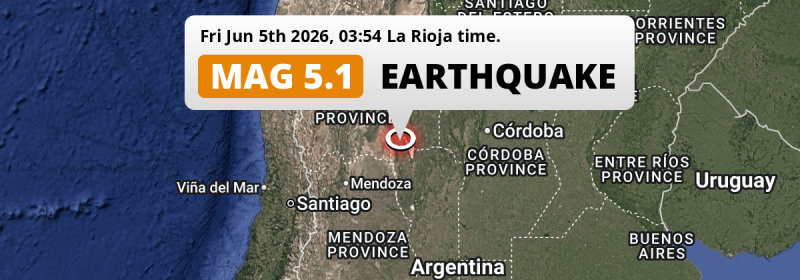
A significant MAG-5.1 earthquake struck under land 146 kilometer from San Juan in Argentina deep in the night of Friday June 5th, 2026.
Felt the earthquake? Share this article: 


Earthquake Summary
The earthquake struck on land in Argentina, 146 kilometer (91 mi) east of San Juan. The center of this earthquake had an intermediate depth of 136 km.
| Date and Time: | Jun 5, 2026 03:54 (San Juan Time) - Jun 5, 2026 06:54 Universal Time. |
|---|---|
| Location: | 146 km east of San Juan, Argentina. Coordinates 31°52'54"S 67°2'43"W. |
| Map: | 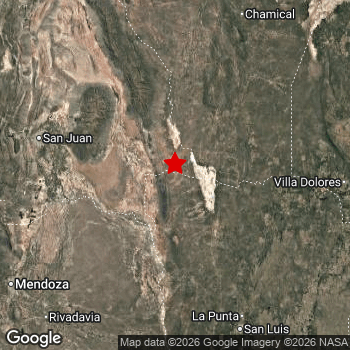 Map of area around epicenter. Click to open in Google Maps. |
| Magnitude: | MAG 5.1 Detected by 25 stations. Maximum Error Range ±0.114 . |
| Depth: | 136 km (85 mi) An intermediate depth. |
| Tsunami Risk: | Tsunami very unlikely Tsunami's are usually caused by MAG-6.5+ earthquakes, less than 100km shallow, and with an epicenter under sea. Neither of this seems to be the case. Always stay cautious - More info here. |
Nearby towns and cities
This earthquake may have been felt in Argentina . Caucete in San Juan, Argentina is the nearest significant place from the epicenter. The earthquake occurred 120 kilometer (75 mi) east of Caucete.
Multiple large cities are in proximity of today's earthquake. Córdoba is located 276 km to the east. Mendoza is located 201 km to the southwest. San Juan is located 146 km to the west.
The table below provides an overview of all places in proximity of today's earthquake.
Overview of nearby places
| Distance | Place |
|---|---|
| 120 km (75 mi) W from epicenter |
Caucete San Juan, Argentina. |
| 142 km (88 mi) W from epicenter |
Santa Lucía San Juan, Argentina. |
| 146 km (91 mi) W from epicenter |
San Juan San Juan, Argentina. |
| 147 km (91 mi) W from epicenter |
Pocito San Juan, Argentina. |
| 148 km (92 mi) W from epicenter |
Chimbas San Juan, Argentina. |
| 148 km (92 mi) W from epicenter |
Villa Paula de Sarmiento San Juan, Argentina. |
| 149 km (93 mi) W from epicenter |
Albardón San Juan, Argentina. |
| 171 km (106 mi) SE from epicenter |
San Luis San Luis, Argentina. |
| 175 km (109 mi) E from epicenter |
Villa Dolores Cordoba, Argentina. |
| 189 km (117 mi) SW from epicenter |
San Martín Mendoza, Argentina. |
| 201 km (125 mi) SW from epicenter |
Mendoza Mendoza, Argentina. |
| 244 km (152 mi) NW from epicenter |
San José de Jáchal San Juan, Argentina. |
| 246 km (153 mi) E from epicenter |
Villa Carlos Paz Cordoba, Argentina. |
| 249 km (155 mi) NE from epicenter |
Cruz del Eje Cordoba, Argentina. |
| 249 km (155 mi) E from epicenter |
Alta Gracia Cordoba, Argentina. |
| 249 km (155 mi) SE from epicenter |
Villa Mercedes San Luis, Argentina. |
| 250 km (155 mi) E from epicenter |
Embalse Cordoba, Argentina. |
| 254 km (158 mi) E from epicenter |
Cosquín Cordoba, Argentina. |
| 258 km (160 mi) E from epicenter |
La Falda Cordoba, Argentina. |
| 263 km (163 mi) E from epicenter |
La Calera Cordoba, Argentina. |
| 269 km (167 mi) E from epicenter |
Villa Allende Cordoba, Argentina. |
| 269 km (167 mi) E from epicenter |
Unquillo Cordoba, Argentina. |
| 270 km (168 mi) E from epicenter |
Río Ceballos Cordoba, Argentina. |
| 275 km (171 mi) N from epicenter |
La Rioja La Rioja, Argentina. |
| 276 km (171 mi) E from epicenter |
Córdoba Cordoba, Argentina. |
| 278 km (173 mi) E from epicenter |
Río Tercero Cordoba, Argentina. |
| 288 km (179 mi) SE from epicenter |
Río Cuarto Cordoba, Argentina. |
| 297 km (185 mi) E from epicenter |
Jesús María Cordoba, Argentina. |
| 297 km (185 mi) E from epicenter |
Río Segundo Cordoba, Argentina. |
3 Aftershocks detected
Since this main shock, 3 smaller aftershocks were detected. A 3.3 magnitude earthquake hit 3 days later 100 km (62 mi) northwest of this earthquake.
In the days before this main shock, 4 smaller foreshocks were detected. Nearby this earthquake a foreshock struck 5 hrs earlier. It measured a magnitude of 3.3
Overview of foreshocks and aftershocks
| Classification | Magnitude | When | Where |
|---|---|---|---|
| Foreshock | M 3.1 |
2 days earlier Jun 2, 2026 21:14 (San Juan Time) | 10 km (6 mi) NE from Main Shock. |
| Foreshock | M 3.3 |
2 days earlier Jun 3, 2026 01:09 (San Juan Time) | 77 km (48 mi) NE from Main Shock. |
| Foreshock | M 2.9 |
7 hrs earlier Jun 4, 2026 20:47 (San Juan Time) | 48 km (30 mi) NW from Main Shock. |
| Foreshock | M 3.3 |
5 hrs earlier Jun 4, 2026 22:29 (San Juan Time) | 97 km (60 mi) W from Main Shock. |
| Main Shock This Earthquake |
M 5.1 |
Jun 5, 2026 03:54 (San Juan Time) | - |
| Aftershock | M 3.0 |
3 hrs later Jun 5, 2026 06:54 (San Juan Time) | 75 km (46 mi) N from Main Shock. |
| Aftershock | M 3.3 |
2 days later Jun 7, 2026 12:44 (San Juan Time) | 88 km (54 mi) SW from Main Shock. |
| Aftershock | M 3.3 |
3 days later Jun 7, 2026 18:30 (San Juan Time) | 100 km (62 mi) NW from Main Shock. |
More earthquakes coming?
Aftershocks are usually at least 1 order of magnitude less strong than main shocks. The more time passes, the smaller the chance and likely strength of any potential aftershocks.
The chance that a significant earthquake like this one is followed by an even larger earthquake is not so large. On average, scientists estimate a 94% chance that a major earthquake will not be followed by an even larger one. It is still adviced to be aware of this risk
Read: How to Stay Safe during an Earthquake (cdc.gov).Earthquakes like this happen often in the region
Earthquakes of this strength are very common in the region. This is the strongest earthquake to hit since October 20th, 2024, when a 5.7 magnitude earthquake hit 198 km (123 mi) further northwest. An even stronger magnitude 6.4 earthquake struck on January 19th, 2021.
In total, 17 earthquakes with a magnitude of 5.1 or higher have been registered within 300km (186 mi) of this epicenter in the past 10 years. This comes down to an average of once every 7 months.
Tsunami very unlikely
It is very unlikely that this eartquake will cause any tsunami's. The reported magnitude is lower than the MAG-6.5 strength required to cause any earthquakes. In addition, this earthquake was not very shallow and appears to have occurred under land. However always stay cautious and monitor advice from local authorities.
Tsunami Risk Factors
| Factor | Under Sea? | MAG-6.5 or stronger? | Shallow depth? |
|---|---|---|---|
| Explanation | Almost all tsunami's are caused by earthquakes with their epicenter under sea or very near the sea. However stay cautious in coastal areas as earthquakes on land may cause landslides into sea, potentially still causing a local tsunami. | Under MAG 6.5: Very unlikely to cause a tsunami. MAG 6.5 to 7.5: Destructive tsunami's do occur, but are uncommon. Likely to observe small sea level changes. MAG 7.6+: Earthquakes with these magnitudes might produce destructive tsunami's. |
Most destructive tsunami's are caused by shallow earthquakes with a depth between 0 and 100km under the surface of the earth. Deeper tsunami's are unlikely to displace to ocean floor. |
| This Earthquake | Not this earthquake. This earthquake appears to have struck on land far from any coast. |
Not this earthquake. This earthquake had a magnitude of 5.1. Earthquakes of this strength are unlikely to trigger a tsunami. |
Not this earthquake. This earthquake occurred at a depth of 136 km (85 mi). Earthquakes this deep in the earth are unlikely to trigger a tsunami. |
Sources
Last updated 26/06/26 09:08 (). This article contains currently available information about the earthquake and is automatically composed. We continue to update this article up to a few days after the earthquake occurred.
- US Geographic Society (USGS): Earthquake us7000sqtb
- European-Mediterranean Seismological Centre (EMSC): Earthquake 20260605_0000104
- Geonames.org: World Cities Database
- Google Maps: Static API
- Earthquakelist.org: Historic Earthquakes Database
Share this article:
