
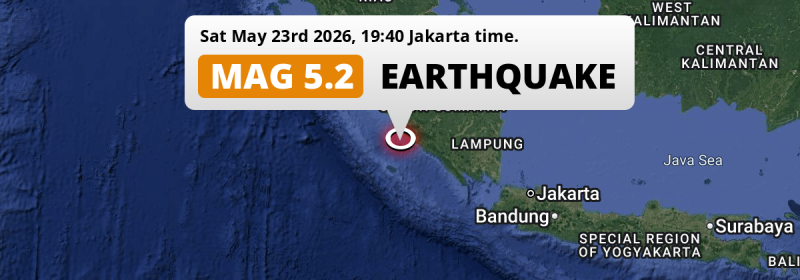
In the evening of Saturday May 23rd, 2026, a significant MAG-5.3 earthquake hit in the Indian Ocean 95 kilometer from Bengkulu, Indonesia.
Felt the earthquake? Share this article: 


Earthquake Summary
This earthquake hit under water in the Indian Ocean, 22 kilometers (14 mi) off the coast of Indonesia, 95 kilometer south-east of Bengkulu. The center of this earthquake had a quite shallow depth of 69 km. Shallow earthquakes usually have a larger impact than earthquakes deep in the earth.
| Date and Time: | May 23, 2026 19:40 (Jakarta Time) - May 23, 2026 12:40 Universal Time. |
|---|---|
| Location: | 95 km SE of Bengkulu, Indonesia. Coordinates 4°32'2"S 102°42'16"E. |
| Map: | 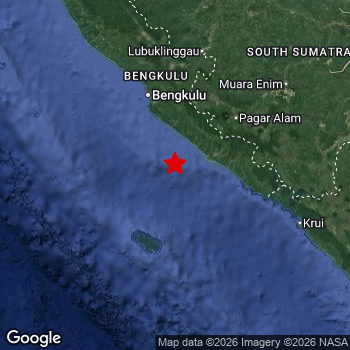 Map of area around epicenter. Click to open in Google Maps. |
| Magnitude: | MAG 5.3 Detected by 128 stations. Maximum Error Range ±0.051 . |
| Depth: | 69 km (43 mi) A quite shallow depth. |
| Tsunami Risk: | Low tsunami risk Earthquakes under MAG-6.5 do not usually cause tsunami's. Always stay cautious - More info here. |
Nearby towns and cities
This earthquake may have been felt in Indonesia . Located 83 kilometer (52 mi) southwest of the epicenter of this earthquake, Pagar Alam (South Sumatra, Indonesia) is the nearest significant population center.
Multiple major population centers exist within 300km of the earthquake that struck today. Palembang is located 289 km to the north-east. Bengkulu is located 95 km to the northwest. Lubuklinggau is located 139 km to the north.
An overview of nearby towns and cities is available in the overview below.
Overview of nearby places
| Distance | Place |
|---|---|
| 83 km (52 mi) NE from epicenter |
Pagar Alam South Sumatra, Indonesia. |
| 95 km (59 mi) NW from epicenter |
Bengkulu Bengkulu, Indonesia. |
| 120 km (75 mi) N from epicenter |
Curup Bengkulu, Indonesia. |
| 125 km (78 mi) NE from epicenter |
Lahat South Sumatra, Indonesia. |
| 139 km (86 mi) N from epicenter |
Lubuklinggau South Sumatra, Indonesia. |
| 139 km (86 mi) NE from epicenter |
Tanjungagung South Sumatra, Indonesia. |
| 168 km (104 mi) E from epicenter |
Baturaja South Sumatra, Indonesia. |
| 209 km (130 mi) NE from epicenter |
Prabumulih South Sumatra, Indonesia. |
| 243 km (151 mi) E from epicenter |
Kotabumi Lampung, Indonesia. |
| 281 km (175 mi) E from epicenter |
Terbanggi Besar Lampung, Indonesia. |
| 289 km (180 mi) NE from epicenter |
Palembang South Sumatra, Indonesia. |
| 295 km (183 mi) E from epicenter |
Metro Lampung, Indonesia. |
Shaking reported by 1 person
People that feel an earthquake may report their experience to the US Geographic Survey. Currently, 1 person has reported shaking in one place in Indonesia.We keep updating this article as more ground reports become available. You may report that you felt this earthquake here.
Places with most reports:
- Lubuk Linggau, Sumatera Selatan, Indonesia: 1 person.
Aftershocks detected
Since this main shock, 1 smaller aftershock was detected. Just 5 hrs after this main shock, an earthquake measuring MAG-4.2 was detected 66 km (41 mi) south of this earthquake.
In the days before this main shock, 3 smaller foreshocks were detected. Roughly 23 hrs before this earthquake, a foreshock measuring MAG-3.6 was detected nearby this earthquake.
Overview of foreshocks and aftershocks
| Classification | Magnitude | When | Where |
|---|---|---|---|
| Foreshock | M 2.5 |
2 days earlier May 22, 2026 01:43 (Jakarta Time) | 69 km (43 mi) S from Main Shock. |
| Foreshock | M 2.9 |
2 days earlier May 22, 2026 06:19 (Jakarta Time) | 44 km (27 mi) SE from Main Shock. |
| Foreshock | M 3.6 |
23 hrs earlier May 22, 2026 20:39 (Jakarta Time) | 47 km (29 mi) SE from Main Shock. |
| Main Shock This Earthquake |
M 5.3 |
May 23, 2026 19:40 (Jakarta Time) | - |
| Aftershock | M 4.2 |
5 hrs later May 24, 2026 01:08 (Jakarta Time) | 66 km (41 mi) S from Main Shock. |
More earthquakes coming?
Earthquakes can create aftershocks. These are generally at least 1 magnitude lower than any main shock, and as time passes the chance and strength of aftershocks decreases.
In only six percent of cases, significant earthquakes are followed by a larger main shock, making the current earthquake a foreshock. While the chance of this happening is not so large, it is adviced to maintain cautiousness in the hours and days following a major earthquake.
Read: How to Stay Safe during an Earthquake (cdc.gov).Earthquakes like this happen often in the region
Earthquakes of this strength are very common in the region. This is the strongest earthquake to hit since December 27th, 2025, when a 5.4 magnitude earthquake hit 118 km (74 mi) further south. An even stronger magnitude 6.9 earthquake struck on November 18th, 2022.
In total, 48 earthquakes with a magnitude of 5.3 or higher have been registered within 300km (186 mi) of this epicenter in the past 10 years. This comes down to an average of once every 3 months.
Low tsunami risk
Based on early data it appears this earthquake was not strong enough (lower than MAG-6.5) to be likely to cause destructive tsunami's. However this earthquake appeared to have hit at a shallow depth under sea, so stay cautious and monitor advice from local authorities.
Tsunami Risk Factors
| Factor | Under Sea? | MAG-6.5 or stronger? | Shallow depth? |
|---|---|---|---|
| Explanation | Almost all tsunami's are caused by earthquakes with their epicenter under sea or very near the sea. However stay cautious in coastal areas as earthquakes on land may cause landslides into sea, potentially still causing a local tsunami. | Under MAG 6.5: Very unlikely to cause a tsunami. MAG 6.5 to 7.5: Destructive tsunami's do occur, but are uncommon. Likely to observe small sea level changes. MAG 7.6+: Earthquakes with these magnitudes might produce destructive tsunami's. |
Most destructive tsunami's are caused by shallow earthquakes with a depth between 0 and 100km under the surface of the earth. Deeper tsunami's are unlikely to displace to ocean floor. |
| This Earthquake | This earthquake appears to have struck under the sea. | Not this earthquake. This earthquake had a magnitude of 5.3. Earthquakes of this strength are unlikely to trigger a tsunami. |
This earthquake occurred at a depth of of 69 km (43 mi). Earthquakes this shallow could trigger a tsunami. |
Sources
Last updated 20/06/26 16:28 (). As more information on this earthquake becomes available this article will be updated. This article is automatically composed based on data originating from multiple sources.
- US Geographic Society (USGS): Earthquake us6000szq3
- European-Mediterranean Seismological Centre (EMSC): Earthquake 20260523_0000179
- Geonames.org: World Cities Database
- Google Maps: Static API
- Earthquakelist.org: Historic Earthquakes Database
Share this article:
