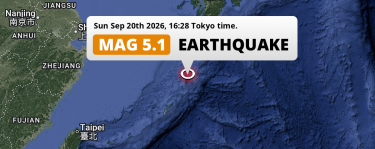
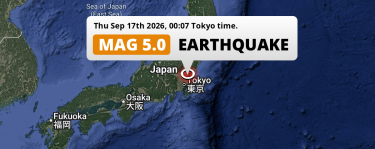
Written by on . Last updated April 27th, 2026.

Under land 37 kilometer from Obihiro in Japan, a strong MAG-6.1 earthquake occurred in the early morning of Monday April 27th, 2026. Roughly 5.2 million people may have felt this earthquake.

Felt the earthquake? Share this article: Share on Facebook Tweet Submit to Reddit Share on LinkedIn

Earthquake Summary

The earthquake struck on land in Japan, 37 kilometer (23 mi) southwest of Obihiro in Hokkaido. The center of this earthquake had an intermediate depth of 81 km.

Date and Time: Apr 27, 2026 05:23 (Tokyo Time)
- Apr 26, 2026 20:23 Universal Time.
Location: 37 km SW of Obihiro, Hokkaido, Japan.
Coordinates 42°37'52"N 142°57'41"E.
Map: Map of area around epicenter.
Map of area around epicenter. Click to open in Google Maps.
Magnitude: MAG 6.1
Detected by 75 stations. Maximum Error Range ±0.036 .
Depth: 81 km (50 mi)
An intermediate depth.
Max. Intensity:
VI
Strong

On the Modified Mercalli Scale.
Tsunami Risk: Tsunami very unlikely
While this was a shallow earthquake, it appears to have occurred under land with a magnitude not strong enough to cause tsunami's.
Always stay cautious - More info here.

Minimal impact predicted

Based on scientific estimates by the US Geographic Survey (USGS), the risk of high fatalities for this earthquake is classified at level GREEN (low). They expect an 90% likelyhood of between 0 and 1 fatalities.

The USGS classifies the economic impact of this earthquake at level GREEN (low). They expect an 90% likelyhood of between 0 and 1 million US Dollars in economic damage and impact.

Roughly 5.2 million people exposed to shaking

The USGS has published a report estimating the number of people exposed to this earthquake. Acoording to their analysis, roughly 5.2 million have been exposed to shaking at an MMI level of II or higher.

The highest earthquake impact level for this earthquake is V, which corresponds with moderate shaking and very light damage. Roughly 338,600 people are expected to be exposed to this level. The majority of people (roughly 4.3 million) live in an area exposed to level IV, where light shaking and likely no damage is expected.

People in 2 countries have been exposed to shaking. Roughly 5.2 million people were exposed to shaking in Japan , with level V (moderate shaking, very light damage) as the highest recorded. In Russia, shaking was experienced too.

People MMI Level Shaking Damage
0
I
Not noticable None
0
II
Very weak None
592,700
III
Weak Probably none
4,272,000
IV
Light Likely none
338,600
V
Moderate Very light
0
VI
Strong Light
0
VII
Very Strong Moderate
0
VIII
Severe Moderate to heavy
0
IX
Violent Heavy
0
X
Extreme Very heavy

Nearby towns and cities

This earthquake may have been felt in Japan . Located 37 kilometer (23 mi) southwest of the epicenter of this earthquake, Obihiro (Hokkaido, Japan) is the nearest significant population center. The intensity of shaking and damage in Obihiro is estimated to be around level V on the Modified Mercalli Intensity scale (moderate shaking, very light damage).

Multiple large cities are in proximity of today's earthquake. Sapporo is located 140 km to the west and experienced an intensity of IV (light shaking, likely no damage). Obihiro is located 37 km to the north-east and experienced an intensity of V (moderate shaking, very light damage). Asahikawa is located 136 km to the north and experienced an intensity of IV (light shaking, likely no damage).

A complete list of nearby places is included below. Estimated intensity data (MMI) sourced from a shake-map published by the US Geographic Survey is shown where available (cities without data probably experienced little impact).

Overview of nearby places

Distance Place Intensity (MMI)
37 km (23 mi)
NE from epicenter
Obihiro

Hokkaido, Japan.
V
Moderate
45 km (28 mi)
NE from epicenter
Otofuke

Hokkaido, Japan.
V
Moderate
59 km (37 mi)
SW from epicenter
Shizunai-furukawachō

Hokkaido, Japan.
V
Moderate
93 km (58 mi)
NW from epicenter
Shimo-furano

Hokkaido, Japan.
V
Moderate
109 km (68 mi)
W from epicenter
Chitose

Hokkaido, Japan.
IV
Light
111 km (69 mi)
W from epicenter
Tomakomai

Hokkaido, Japan.
IV
Light
116 km (72 mi)
NW from epicenter
Ashibetsu

Hokkaido, Japan.
IV
Light
117 km (73 mi)
NW from epicenter
Iwamizawa

Hokkaido, Japan.
IV
Light
118 km (73 mi)
NW from epicenter
Bibai

Hokkaido, Japan.
IV
Light
120 km (75 mi)
W from epicenter
Kitahiroshima

Hokkaido, Japan.
IV
Light
121 km (75 mi)
E from epicenter
Kushiro

Hokkaido, Japan.
IV
Light
127 km (79 mi)
NW from epicenter
Ebetsu

Hokkaido, Japan.
IV
Light
128 km (80 mi)
NW from epicenter
Sunagawa

Hokkaido, Japan.
IV
Light
132 km (82 mi)
W from epicenter
Shiraoi

Hokkaido, Japan.
IV
Light
134 km (83 mi)
NW from epicenter
Tōbetsu

Hokkaido, Japan.
IV
Light
134 km (83 mi)
NW from epicenter
Takikawa

Hokkaido, Japan.
IV
Light
136 km (85 mi)
N from epicenter
Asahikawa

Hokkaido, Japan.
IV
Light
140 km (87 mi)
W from epicenter
Sapporo

Hokkaido, Japan.
IV
Light
141 km (88 mi)
NW from epicenter
Fukagawa

Hokkaido, Japan.
IV
Light
147 km (91 mi)
NW from epicenter
Ishikari

Hokkaido, Japan.
IV
Light
151 km (94 mi)
NE from epicenter
Kitami

Hokkaido, Japan.
IV
Light
162 km (101 mi)
NE from epicenter
Motomachi

Hokkaido, Japan.
IV
Light
166 km (103 mi)
W from epicenter
Muroran

Hokkaido, Japan.
IV
Light
171 km (106 mi)
W from epicenter
Otaru

Hokkaido, Japan.
IV
Light
172 km (107 mi)
W from epicenter
Date

Hokkaido, Japan.
IV
Light
176 km (109 mi)
N from epicenter
Minamishibetsuchō

Hokkaido, Japan.
IV
Light
180 km (112 mi)
NW from epicenter
Rumoi

Hokkaido, Japan.
IV
Light
187 km (116 mi)
NE from epicenter
Abashiri

Hokkaido, Japan.
IV
Light
189 km (117 mi)
W from epicenter
Yoichi

Hokkaido, Japan.
IV
Light
192 km (119 mi)
NE from epicenter
Nakashibetsu

Hokkaido, Japan.
IV
Light
194 km (121 mi)
N from epicenter
Mombetsu

Hokkaido, Japan.
III
Weak
195 km (121 mi)
N from epicenter
Nayoro

Hokkaido, Japan.
IV
Light
204 km (127 mi)
SW from epicenter
Honchō

Hokkaido, Japan.
III
Weak
206 km (128 mi)
SW from epicenter
Hakodate

Hokkaido, Japan.
IV
Light
208 km (129 mi)
SW from epicenter
Mutsu

Aomori, Japan.
IV
Light
210 km (130 mi)
NE from epicenter
Shibetsu

Hokkaido, Japan.
IV
Light
211 km (131 mi)
SW from epicenter
Kamiiso

Hokkaido, Japan.
IV
Light
226 km (140 mi)
E from epicenter
Nemuro

Hokkaido, Japan.
253 km (157 mi)
SW from epicenter
Misawa

Aomori, Japan.
266 km (165 mi)
SW from epicenter
Hachinohe

Aomori, Japan.
274 km (170 mi)
SW from epicenter
Aomori

Aomori, Japan.
III
Weak
290 km (180 mi)
SW from epicenter
Namioka

Aomori, Japan.
292 km (181 mi)
SW from epicenter
Goshogawara

Aomori, Japan.
295 km (183 mi)
SW from epicenter
Shimokizukuri

Aomori, Japan.
296 km (184 mi)
SW from epicenter
Kuroishi

Aomori, Japan.
307 km (191 mi)
SW from epicenter
Hirosaki

Aomori, Japan.
326 km (203 mi)
N from epicenter
Wakkanai

Hokkaido, Japan.
330 km (205 mi)
SW from epicenter
Ōdate

Akita, Japan.
343 km (213 mi)
S from epicenter
Miyako

Iwate, Japan.
359 km (223 mi)
SW from epicenter
Morioka

Iwate, Japan.
393 km (244 mi)
SW from epicenter
Hanamaki

Iwate, Japan.
Cities and Towns around the epicenter of this earthquake.

Earthquake Intensity Map

The graph below overlays a map of the region around the epicenter with earthquake intensity data provided by the US Geographic Survey. The highest intensity level detected for this earthquake is V.

I Not felt
II Weak
III Weak
IV Light
V Moderate
VI Strong
VII Very Strong
VIII Severe
IX Violent
X Extreme
Earthquake Intensity Map based on Shakemap Data provided by USGS.

Shaking reported by 16 people

People that feel an earthquake may report their experience to the US Geographic Survey. Currently, 16 people have reported shaking in 10 places, all within Japan.We keep updating this article as more ground reports become available. You may report that you felt this earthquake here.

Places with most reports:

  • Sapporo, Hokkaido, Japan: 6 people.
  • Nakashibetsu, Hokkaido, Japan: 2 people.
  • Obihiro, Hokkaido, Japan: 1 person.
  • Muroran, Hokkaido, Japan: 1 person.
  • Hakodate, Hokkaido, Japan: 1 person.
  • Chitose, Hokkaido, Japan: 1 person.
  • Sendai, Miyagi, Japan: 1 person.
  • Aomori, Aomori, Japan: 1 person.
  • Kashiwa, Chiba, Japan: 1 person.
  • Iwanai, Hokkaido, Japan: 1 person.

Risk of aftershocks?

This earthquake did not have any significant foreshocks nor aftershocks occurring within 100km (62 mi) of its epicenter.

The risk of aftershocks decreases rapidly over time. Usually, aftershocks are at least one order of magnitude lower than a main shock.

In only six percent of cases, significant earthquakes are followed by a larger main shock, making the current earthquake a foreshock. While the chance of this happening is not so large, it is adviced to maintain cautiousness in the hours and days following a major earthquake.

Read: How to Stay Safe during an Earthquake (cdc.gov).

Earthquakes like this are common in the region

Earthquakes of this strength occur quite regularly in the region. This is the strongest earthquake to hit since April 20th, 2026, when a 7.4 magnitude earthquake hit 298 km (185 mi) further south. An even stronger magnitude 7.6 earthquake struck on December 8th, 2025.

In total, 8 earthquakes with a magnitude of 6.1 or higher have been registered within 300km (186 mi) of this epicenter in the past 10 years. This comes down to an average of once every year.

Tsunami very unlikely

DISCLAIMER: We strongly suggest to closely monitor advice from local authorities with regards to tsunami risks. Our analysis is based on automatically collected data from external sources, and these might contain mistakes. In addition, earthquakes can cause landslides that may lead to a tsunami, or be a followed by another, potentially stonger, earthquake.

While MAG-6.5+ earthquakes may cause tsunami's, it appears that the epicenter of this earthquake hit under land. In addition, the reported depth is deeper than 100km, making the risk of a tsunami even less likely. However always stay cautious and monitor advice from local authorities.

Tsunami Risk Factors

Factor Under Sea? MAG-6.5 or stronger? Shallow depth?
Explanation Almost all tsunami's are caused by earthquakes with their epicenter under sea or very near the sea. However stay cautious in coastal areas as earthquakes on land may cause landslides into sea, potentially still causing a local tsunami. Under MAG 6.5: Very unlikely to cause a tsunami.
MAG 6.5 to 7.5: Destructive tsunami's do occur, but are uncommon. Likely to observe small sea level changes.
MAG 7.6+: Earthquakes with these magnitudes might produce destructive tsunami's.
Most destructive tsunami's are caused by shallow earthquakes with a depth between 0 and 100km under the surface of the earth. Deeper tsunami's are unlikely to displace to ocean floor.
This Earthquake Not this earthquake.
This earthquake appears to have struck on land far from any coast.
Not this earthquake.
This earthquake had a magnitude of 6.1. Earthquakes of this strength are unlikely to trigger a tsunami.
This earthquake occurred at a depth of of 81 km (50 mi). Earthquakes this shallow could trigger a tsunami.

Sources

Last updated 27/04/26 12:08 (). As more information on this earthquake becomes available this article will be updated. This article is automatically composed based on data originating from multiple sources.

  1. US Geographic Society (USGS): Earthquake us6000st1m
  2. European-Mediterranean Seismological Centre (EMSC): Earthquake 20260426_0000350
  3. Geonames.org: World Cities Database
  4. Google Maps: Static API
  5. Earthquakelist.org: Historic Earthquakes Database

Share this article: Share on Facebook Tweet Submit to Reddit Share on LinkedIn