
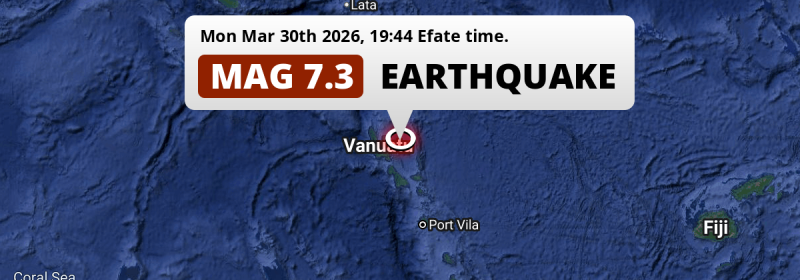
In the evening of Monday March 30th, 2026, an unusually powerful Magnitude 7.3 earthquake hit in the Coral Sea 281 kilometer from Port-Vila, Vanuatu. Shaking may have been felt by a total of 280 thousand people.
Felt the earthquake? Share this article: 


Earthquake Summary
This earthquake hit under water in the Coral Sea, right off the coast of Vanuatu (12 mi offshore), 281 kilometer north of Port-Vila in Shefa. The center of this earthquake had an intermediate depth of 121 km.
| Date and Time: | Mar 30, 2026 07:44PM (Efate Time) - Mar 30, 2026 08:44 Universal Time. |
|---|---|
| Location: | 281 km north of Port-Vila, Shefa, Vanuatu. Coordinates 15°18'50"S 167°33'42"E. |
| Map: | 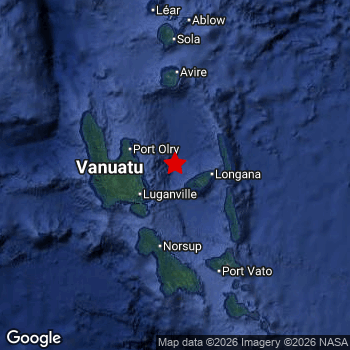 Map of area around epicenter. Click to open in Google Maps. |
| Magnitude: | MAG 7.3 Detected by 18 stations. Maximum Error Range ±0.034 . |
| Depth: | 121 km (75 mi) An intermediate depth. |
| Max. Intensity: | VII
Very Strong On the Modified Mercalli Scale. |
| Tsunami Risk: | Small (but not impossible) Tsunami Risk Mag 6.5+ earthquakes under sea may cause tsunami's, but the risk is lower as this earthquake appears not to be very shallow. Always stay cautious - More info here. |
Minimal impact predicted
Based on scientific estimates by the US Geographic Survey (USGS), the risk of high fatalities for this earthquake is classified at level GREEN (low). They expect an 90% likelyhood of between 0 and 1 fatalities.
The USGS classifies the economic impact of this earthquake at level GREEN (low). They expect an 90% likelyhood of between 0 and 1 million US Dollars in economic damage and impact.
Roughly 280 thousand people exposed to shaking
An estimated 280 thousand have been exposed to shaking (An MMI or Modified Mercalli Intensity level II or higher) as a result of this earthquake according scientific estimates published by the USGS.
The highest earthquake impact level for this earthquake is VII, which corresponds with very strong shaking and likely moderate damage. Roughly 80 people are expected to be exposed to this level. Intensity level VI was experienced by a large group of people (around 130 thousand). In their region, strong shaking and probably light damage can be expected. All exposure to shaking was within the borders of Vanuatu .
| People | MMI Level | Shaking | Damage |
|---|---|---|---|
| 0 | I |
Not noticable | None |
| 0 | II |
Very weak | None |
| 0 | III |
Weak | Probably none |
| 96,940 | IV |
Light | Likely none |
| 48,650 | V |
Moderate | Very light |
| 134,800 | VI |
Strong | Light |
| 80 | VII |
Very Strong | Moderate |
| 0 | VIII |
Severe | Moderate to heavy |
| 0 | IX |
Violent | Heavy |
| 0 | X |
Extreme | Very heavy |
Nearby towns and cities
This earthquake may have been felt in Vanuatu . Port-Vila in Shefa, Vanuatu is the nearest significant place from the epicenter. The earthquake occurred 281 kilometer (175 mi) north of Port-Vila. The intensity of shaking and damage in Port-Vila is estimated to be around level IV on the Modified Mercalli Intensity scale (light shaking, likely no damage).
Overview of nearby places
| Distance | Place | Intensity (MMI) |
|---|---|---|
| 281 km (175 mi) S from epicenter |
Port-Vila Shefa, Vanuatu. |
IV
Light |
Earthquake Intensity Map
The intensity in shaking and damage by this earthquake is illustrated through the map below. The highest intensity measured for this earthquake is VII.

Shaking reported by 31 people in 2 countries
People that feel an earthquake may report their experience to the US Geographic Survey. Currently, 31 people have reported shaking in 8 places in 2 countries (Vanuatu, New Caledonia).We keep updating this article as more ground reports become available. You may report that you felt this earthquake here.
Places with most reports:
- Vila, Shefa, Vanuatu: 18 people.
- Luganville, Sanma, Vanuatu: 4 people.
- Nouméa, Sud, New Caledonia: 4 people.
- Port Olry, Sanma, Vanuatu: 1 person.
- Longana, Penama, Vanuatu: 1 person.
- Isangel, Tafea, Vanuatu: 1 person.
- Lakatoro, Malampa, Vanuatu: 1 person.
- Houaïlu, Nord, New Caledonia: 1 person.
2 Aftershocks detected
After this earthquake struck, 2 smaller aftershocks occurred. A 5 magnitude earthquake hit 18 mins later 12 km (8 mi) south-east of this earthquake.
Overview of foreshocks and aftershocks
| Classification | Magnitude | When | Where |
|---|---|---|---|
| Main Shock | M 5.4 |
Mar 30, 2026 07:44PM (Efate Time) | - |
| Aftershock | M 5.0 |
18 mins later Mar 30, 2026 08:02PM (Efate Time) | 12 km (8 mi) SE from Main Shock. |
| Aftershock | M 4.8 |
11 hrs later Mar 31, 2026 06:50AM (Efate Time) | 69 km (43 mi) NW from Main Shock. |
More earthquakes coming?
Aftershocks are usually at least 1 order of magnitude less strong than main shocks. The more time passes, the smaller the chance and likely strength of any potential aftershocks.
It's always adviced to be cautious of the risk of a larger shock following any significant earthquake, however this risk is fairly small. There is a roughly 94 percent change that no larger main shock will follow in the days following this earthquake.
Read: How to Stay Safe during an Earthquake (cdc.gov).This is an unusually powerful earthquake
Earthquakes of this strength are not so common in the region, but it's not the first time. This is the strongest earthquake to hit since December 17th, 2024, when a 7.3 magnitude earthquake hit 270 km (168 mi) further south. That was also the heaviest earthquake to hit the region in the past 10 years.
In total, 1 earthquake with a magnitude of 7.3 or higher have been registered within 300km (186 mi) of this epicenter in the past 10 years. This comes down to an average of once every 10 years.
Small (but not impossible) Tsunami Risk
Tsunami's are usually triggered by shallow earthquakes occurring at a maximum depth of a 100km. Based on early data it appears this earthquake was not shallow. However this was a very strong earthquake with it's epicenter under sea. Stay very cautious and monitor advice from local authorities.
Tsunami Risk Factors
| Factor | Under Sea? | MAG-6.5 or stronger? | Shallow depth? |
|---|---|---|---|
| Explanation | Almost all tsunami's are caused by earthquakes with their epicenter under sea or very near the sea. However stay cautious in coastal areas as earthquakes on land may cause landslides into sea, potentially still causing a local tsunami. | Under MAG 6.5: Very unlikely to cause a tsunami. MAG 6.5 to 7.5: Destructive tsunami's do occur, but are uncommon. Likely to observe small sea level changes. MAG 7.6+: Earthquakes with these magnitudes might produce destructive tsunami's. |
Most destructive tsunami's are caused by shallow earthquakes with a depth between 0 and 100km under the surface of the earth. Deeper tsunami's are unlikely to displace to ocean floor. |
| This Earthquake | This earthquake appears to have struck under the sea. | This earthquake had a magnitude of 7.3. Earthquakes of this strength could trigger a tsunami. | Not this earthquake. This earthquake occurred at a depth of 121 km (75 mi). Earthquakes this deep in the earth are unlikely to trigger a tsunami. |
Sources
Last updated 31/03/26 21:08 (). This article is automatically generated based on available data. We keep checking multiple sources for additional information. This article gets updated as new details on this earthquake become available.
- US Geographic Society (USGS): Earthquake us7000s8q0
- European-Mediterranean Seismological Centre (EMSC): Earthquake 20260330_0000126
- Geonames.org: World Cities Database
- Google Maps: Static API
- Earthquakelist.org: Historic Earthquakes Database
Share this article:
