
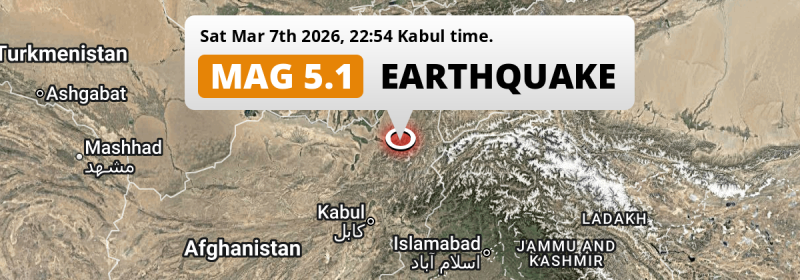
Under land 62 kilometer from Taloqan in Afghanistan, a significant Magnitude 5.1 earthquake occurred in the evening of Saturday March 7th, 2026. Other nearby countries are Tajikistan, Pakistan and Uzbekistan.
Felt the earthquake? Share this article: 


Earthquake Summary
The earthquake struck on land in Afghanistan, 62 kilometer (39 mi) east of Taloqan in Takhar. The center of this earthquake had an intermediate depth of 209 km.
| Date and Time: | Mar 7, 2026 10:54PM (Kabul Time) - Mar 7, 2026 18:24 Universal Time. |
|---|---|
| Location: | 62 km east of Taloqan, Takhar, Afghanistan. Coordinates 36°32'25"N 70°11'9"E. |
| Map: | 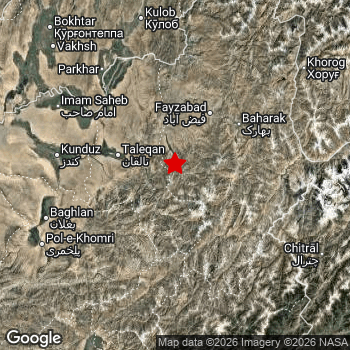 Map of area around epicenter. Click to open in Google Maps. |
| Magnitude: | MAG 5.1 Detected by 11 stations. Maximum Error Range ±0.093 . |
| Depth: | 209 km (130 mi) An intermediate depth. |
| Tsunami Risk: | Tsunami very unlikely Tsunami's are usually caused by MAG-6.5+ earthquakes, less than 100km shallow, and with an epicenter under sea. Neither of this seems to be the case. Always stay cautious - More info here. |
Nearby towns and cities
Afghanistan , Tajikistan , Pakistan and Uzbekistan are all located within 300km distance of the epicenter of the earthquake.
Taloqan in Takhar, Afghanistan is the nearest significant place from the epicenter. The earthquake occurred 62 kilometer (39 mi) east of Taloqan.
Multiple major population centers exist within 300km of the earthquake that struck today. Kabul is located 242 km to the south. Dushanbe is located 254 km to the northwest. Kunduz is located 120 km to the west.
An overview of nearby towns and cities is available in the overview below.
Overview of nearby places
| Distance | Place |
|---|---|
| 62 km (39 mi) W from epicenter |
Taloqan Takhar, Afghanistan. |
| 72 km (45 mi) NW from epicenter |
Rustāq Takhar, Afghanistan. |
| 73 km (45 mi) NE from epicenter |
Fayzabad Badakhshan, Afghanistan. |
| 87 km (54 mi) NW from epicenter |
Ārt Khwājah Takhar, Afghanistan. |
| 97 km (60 mi) W from epicenter |
Khanabad Kunduz, Afghanistan. |
| 108 km (67 mi) SW from epicenter |
Nahrīn Baghlan, Afghanistan. |
| 120 km (75 mi) W from epicenter |
Kunduz Kunduz, Afghanistan. |
| 127 km (79 mi) N from epicenter |
Chubek Khatlon, Tajikistan. |
| 127 km (79 mi) NW from epicenter |
Farkhor Khatlon, Tajikistan. |
| 129 km (80 mi) E from epicenter |
Ishqoshim Gorno-Badakhshan, Tajikistan. |
| 140 km (87 mi) W from epicenter |
Baghlān Baghlan, Afghanistan. |
| 146 km (91 mi) NW from epicenter |
Qarāwul Kunduz, Afghanistan. |
| 148 km (92 mi) SW from epicenter |
Pul-e Khumrī Baghlan, Afghanistan. |
| 149 km (93 mi) N from epicenter |
Hulbuk Khatlon, Tajikistan. |
| 149 km (93 mi) SW from epicenter |
Bāzārak Panjshir, Afghanistan. |
| 157 km (98 mi) N from epicenter |
Kŭlob Khatlon, Tajikistan. |
| 161 km (100 mi) NE from epicenter |
Khorugh Gorno-Badakhshan, Tajikistan. |
| 177 km (110 mi) NW from epicenter |
Vakhsh Khatlon, Tajikistan. |
| 179 km (111 mi) NW from epicenter |
Kolkhozobod Khatlon, Tajikistan. |
| 180 km (112 mi) SW from epicenter |
Jabal os Saraj Parwan, Afghanistan. |
| 185 km (115 mi) NW from epicenter |
Moskovskiy Khatlon, Tajikistan. |
| 188 km (117 mi) NW from epicenter |
Danghara Khatlon, Tajikistan. |
| 191 km (119 mi) NW from epicenter |
Bokhtar Khatlon, Tajikistan. |
| 193 km (120 mi) SW from epicenter |
Charikar Parwan, Afghanistan. |
| 197 km (122 mi) W from epicenter |
Aībak Samangan, Afghanistan. |
| 198 km (123 mi) SE from epicenter |
Āsmār Kunar, Afghanistan. |
| 205 km (127 mi) SE from epicenter |
Asadābād Kunar, Afghanistan. |
| 208 km (129 mi) S from epicenter |
Mehtar Lām Laghman, Afghanistan. |
| 213 km (132 mi) SE from epicenter |
Upper Dir Khyber Pakhtunkhwa, Pakistan. |
| 219 km (136 mi) N from epicenter |
Norak Khatlon, Tajikistan. |
| 220 km (137 mi) SE from epicenter |
Thal Khyber Pakhtunkhwa, Pakistan. |
| 222 km (138 mi) NW from epicenter |
Yovon Khatlon, Tajikistan. |
| 223 km (139 mi) W from epicenter |
Khulm Balkh, Afghanistan. |
| 236 km (147 mi) S from epicenter |
Jalālābād Nangarhar, Afghanistan. |
| 242 km (150 mi) S from epicenter |
Kabul Kabul, Afghanistan. |
| 244 km (152 mi) SW from epicenter |
Paghmān Kabul, Afghanistan. |
| 246 km (153 mi) NW from epicenter |
Boshkengash Dushanbe, Tajikistan. |
| 247 km (153 mi) NW from epicenter |
Vahdat Republican Subordination, Tajikistan. |
| 254 km (158 mi) NW from epicenter |
Dushanbe Dushanbe, Tajikistan. |
| 264 km (164 mi) NW from epicenter |
Hisor Republican Subordination, Tajikistan. |
| 267 km (166 mi) NW from epicenter |
Sho‘rchi Surxondaryo, Uzbekistan. |
| 268 km (167 mi) SE from epicenter |
Bat Khela Khyber Pakhtunkhwa, Pakistan. |
| 270 km (168 mi) W from epicenter |
Tirmiz Surxondaryo, Uzbekistan. |
| 275 km (171 mi) W from epicenter |
Mazār-e Sharīf Balkh, Afghanistan. |
| 277 km (172 mi) SE from epicenter |
Mingora Khyber Pakhtunkhwa, Pakistan. |
| 279 km (173 mi) NW from epicenter |
Tursunzoda Republican Subordination, Tajikistan. |
| 279 km (173 mi) NW from epicenter |
Denov Surxondaryo, Uzbekistan. |
| 282 km (175 mi) SE from epicenter |
Tangi Khyber Pakhtunkhwa, Pakistan. |
| 286 km (178 mi) SW from epicenter |
Bāmyān Bamyan, Afghanistan. |
| 287 km (178 mi) SE from epicenter |
Shabqadar Khyber Pakhtunkhwa, Pakistan. |
| 294 km (183 mi) W from epicenter |
Balkh Balkh, Afghanistan. |
Shaking reported by 1 person
People that feel an earthquake may report their experience to the US Geographic Survey. Currently, 1 person has reported shaking in one place in Afghanistan.We keep updating this article as more ground reports become available. You may report that you felt this earthquake here.
Places with most reports:
- Kabul, Kabul, Afghanistan: 1 person.
2 Aftershocks detected
Since this main shock, 2 smaller aftershocks were detected. At a distance of 100 km (62 mi) east of this earthquake, an aftershock struck 12 hrs later. It measured a magnitude of 4.5
In the days before this main shock, 1 smaller foreshock was detected. A 4.2 magnitude earthquake hit 15 hrs earlier nearby.
Overview of foreshocks and aftershocks
| Classification | Magnitude | When | Where |
|---|---|---|---|
| Foreshock | M 4.2 |
15 hrs earlier Mar 7, 2026 07:58AM (Kabul Time) | 84 km (52 mi) SE from Main Shock. |
| Main Shock This Earthquake |
M 5.1 |
Mar 7, 2026 10:54PM (Kabul Time) | - |
| Aftershock | M 4.5 |
12 hrs later Mar 8, 2026 10:33AM (Kabul Time) | 100 km (62 mi) E from Main Shock. |
| Aftershock | M 4.4 |
2 days later Mar 10, 2026 06:36AM (Kabul Time) | 97 km (60 mi) NW from Main Shock. |
More earthquakes coming?
Earthquakes can create aftershocks. These are generally at least 1 magnitude lower than any main shock, and as time passes the chance and strength of aftershocks decreases.
In only six percent of cases, significant earthquakes are followed by a larger main shock, making the current earthquake a foreshock. While the chance of this happening is not so large, it is adviced to maintain cautiousness in the hours and days following a major earthquake.
Read: How to Stay Safe during an Earthquake (cdc.gov).Earthquakes like this happen often in the region
Earthquakes of this strength are very common in the region. This is the strongest earthquake to hit since February 25th, 2026, when a 5.4 magnitude earthquake hit 133 km (83 mi) further north-east. An even stronger magnitude 6.6 earthquake struck on April 10th, 2016.
In total, 53 earthquakes with a magnitude of 5.1 or higher have been registered within 300km (186 mi) of this epicenter in the past 10 years. This comes down to an average of once every 2 months.
Tsunami very unlikely
It is very unlikely that this eartquake will cause any tsunami's. The reported magnitude is lower than the MAG-6.5 strength required to cause any earthquakes. In addition, this earthquake was not very shallow and appears to have occurred under land. However always stay cautious and monitor advice from local authorities.
Tsunami Risk Factors
| Factor | Under Sea? | MAG-6.5 or stronger? | Shallow depth? |
|---|---|---|---|
| Explanation | Almost all tsunami's are caused by earthquakes with their epicenter under sea or very near the sea. However stay cautious in coastal areas as earthquakes on land may cause landslides into sea, potentially still causing a local tsunami. | Under MAG 6.5: Very unlikely to cause a tsunami. MAG 6.5 to 7.5: Destructive tsunami's do occur, but are uncommon. Likely to observe small sea level changes. MAG 7.6+: Earthquakes with these magnitudes might produce destructive tsunami's. |
Most destructive tsunami's are caused by shallow earthquakes with a depth between 0 and 100km under the surface of the earth. Deeper tsunami's are unlikely to displace to ocean floor. |
| This Earthquake | Not this earthquake. This earthquake appears to have struck on land far from any coast. |
Not this earthquake. This earthquake had a magnitude of 5.1. Earthquakes of this strength are unlikely to trigger a tsunami. |
Not this earthquake. This earthquake occurred at a depth of 209 km (130 mi). Earthquakes this deep in the earth are unlikely to trigger a tsunami. |
Sources
Last updated 01/04/26 03:28 (). This article is automatically generated based on available data. We keep checking multiple sources for additional information. This article gets updated as new details on this earthquake become available.
- US Geographic Society (USGS): Earthquake us7000s2v0
- European-Mediterranean Seismological Centre (EMSC): Earthquake 20260307_0000263
- Geonames.org: World Cities Database
- Google Maps: Static API
- Earthquakelist.org: Historic Earthquakes Database
Share this article:
